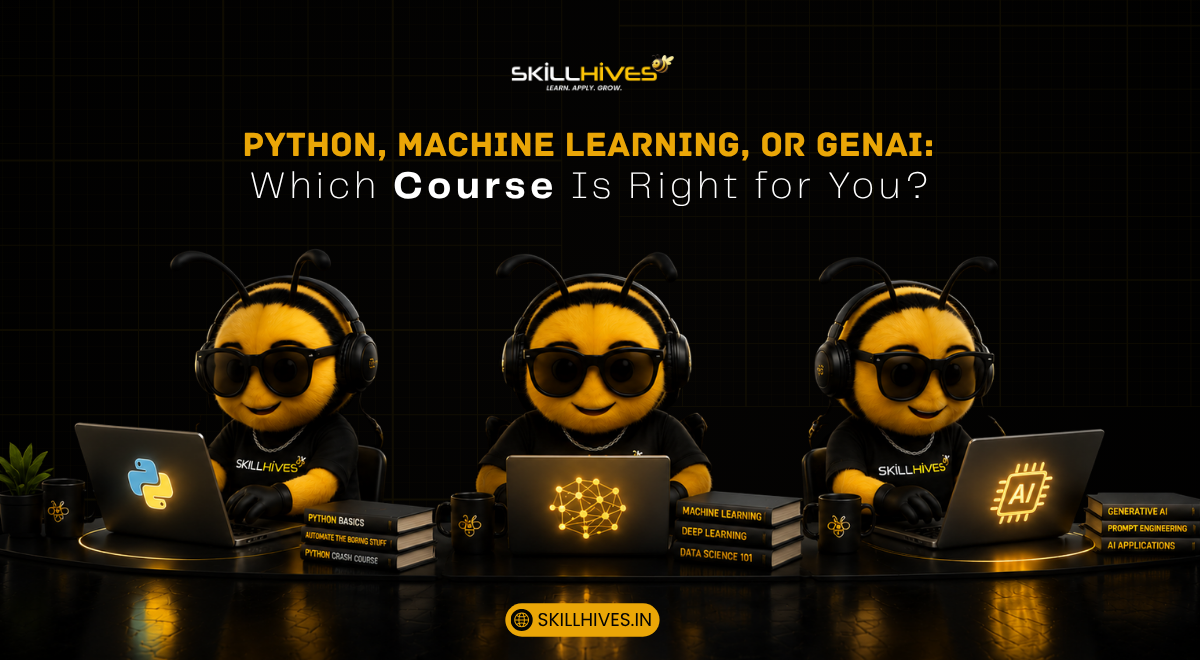
Python, Machine Learning, or GenAI: Which Course Is Right for You?
-
By Devraj
-
2nd September 2026
If you’re trying to enter the AI/tech field, you’ve probably run into the same wall most students do: Python, Machine Learning, and GenAI courses all keep showing up when searching for an IT training company, and all three sound important. Whether you are looking for short-term skill development or a 6 months industrial training program, picking the wrong starting point can make learning harder than it needs to be because these fields serve genuinely different purposes.
This guide is built to fix that confusion. By the end, you’ll know what Python, Machine Learning, and GenAI actually mean, what you’ll learn in each course, who should choose each one, what skills you need before starting, and which learning path is likely to suit you best based on your current knowledge, interests, and career goals.
Ready to fast-track your tech career?
Explore our 6 months industrial training program today!”
Python, Machine Learning and GenAI: What Is the Difference?
Here’s the simple version before we go deeper:
| Technology | Simple Meaning | Main Purpose |
|---|---|---|
| Python | A programming language | Build programs and applications |
| Machine Learning | A way for computers to learn from data | Make predictions and decisions |
| GenAI | AI that can create new content | Generate text, images, code and more |
Python is the foundation a language used to write instructions a computer can follow. Machine Learning builds on that foundation, using code and data together to let a system identify patterns and make predictions rather than following fixed rules. GenAI goes a step further, using trained models to actually generate new content, text, images, code rather than just analyzing existing data.
What Is Python and Why Is It Important for AI?
What Can You Do With Python?
Python is used to build applications, automate repetitive tasks, work with and analyze data, create websites, and increasingly, work directly with AI and ML tools and libraries.
What Will You Learn in a Python Course?
A solid Python training program typically covers variables, data types, conditions, loops, functions, object-oriented programming, commonly used libraries, and hands-on beginner projects to apply everything you’ve learned.
Who Should Learn Python?
Python suits complete beginners, college students, students specifically interested in coding, students planning to eventually enter AI/ML, and anyone simply wanting a solid programming foundation before specializing further.
Do You Need Previous Coding Experience?
No. Python is generally a strong starting point for students who are completely new to programming.
What Is Machine Learning?
Think about how Netflix recommends a movie, or how an online store suggests a product you might like, machine learning is what powers that. It helps systems identify patterns in existing user data and use those patterns to make predictions, without a programmer writing an explicit rule for every possible scenario.
How Does Machine Learning Work?
In simple terms: Data → Training → Model → Prediction.
What Will You Learn in Machine Learning?
A typical ML course covers Python basics, data handling, data preprocessing, core ML algorithms, model training, model testing, prediction, and practical, hands-on projects.
Who Should Learn Machine Learning?
This path suits students interested in AI generally, students who enjoy problem-solving, students drawn to working with data, students who already know basic Python, and anyone aiming toward a technical AI career.
Is Machine Learning Difficult for Beginners?
Honestly, yes more so than basic Python. ML often requires understanding coding, data handling, some statistics, and algorithmic thinking together, which is why it’s usually easier to approach after some programming foundation is already in place.
What Is Generative AI?
What Can Generative AI Do?
GenAI can generate text, create images, generate code, summarize information, help brainstorm ideas, and power entire AI-driven applications built around these capabilities.
What Do You Learn in a GenAI Course?
Depending on the specific course, students may learn generative AI concepts, prompt engineering, how large language models work, working with AI tools and APIs, AI application development, AI automation, and practical, applied projects.
Who Should Learn GenAI?
This path fits students interested in modern AI tools specifically, developers, students interested in building AI-powered applications, anyone curious about LLMs, and students who want to build real, usable AI-driven solutions.
Can You Learn GenAI Without Python?
It depends on your goal. For basic GenAI usage, using existing tools and prompting effectively, Python may not be necessary at all. For technical GenAI development, actually building applications or working with APIs, Python and general programming knowledge become genuinely useful.
Python vs Machine Learning vs GenAI: Complete Comparison
| Factor | Python | Machine Learning | GenAI |
|---|---|---|---|
| Beginner Level | Easy | Moderate | Moderate |
| Main Focus | Programming | Data & prediction | AI content generation |
| Coding | Required | Required | Depends on course |
| Mathematics | Low | Medium/High | Depends |
| Best Starting Point | Yes | Usually after Python | Depends on goal |
| Good For | Coding foundation | AI/ML | Modern AI applications |
| Practical Work | Programs & automation | ML models | AI applications |
| Recommended For | Beginners | Aspiring ML learners | AI-focused learners |
Which Course Should You Choose Based on Your Goal?
If You Are Completely New to Coding
Choose Python. It’s the most beginner-friendly entry point, and everything else in AI eventually builds on programming fundamentals anyway.
If You Already Know Python
Consider Machine Learning. You already have the foundation needed to focus on data, algorithms, and model-building without getting stuck on basic syntax.
If You Want to Build AI Applications
Consider GenAI. Skills like prompt engineering, working with APIs, and understanding LLMs will help you build real, usable AI-powered tools.
If You Want a Long-Term AI Career
A common progression looks like Python → Machine Learning → GenAI though this is one possible path, not a compulsory rule everyone has to follow in that exact order.
Which Course Is Right for You? Quick Decision Table
| Your Situation | Best Starting Choice |
|---|---|
| I have never coded before | Python |
| I want to learn programming | Python |
| I know basic Python | Machine Learning |
| I enjoy working with data | Machine Learning |
| I want to understand AI models | Machine Learning |
| I want to work with ChatGPT-like technology | GenAI |
| I want to build AI applications | GenAI + Python |
| I want a broader AI learning path | Python → ML → GenAI |
What Should You Know Before Starting Each Course?
| Course | What You Should Know Before Starting |
|---|---|
| Python | Basic computer knowledge |
| Machine Learning | Python basics, basic mathematics and data concepts |
| GenAI Basics | Basic AI understanding and willingness to experiment |
| Technical GenAI | Python/programming can be helpful |
Keep in mind that prerequisites can vary somewhat from one institute or course to another, so it’s always worth confirming directly before enrolling.
What Skills Will You Build After Each Course?
- Python Skills — programming logic, problem-solving, automation, application development, and working comfortably with Python libraries.
- Machine Learning Skills — With ML courses you can build skills including data preparation, model building, model evaluation, prediction, and a real understanding of how different ML algorithms actually work.
- GenAI Skills — effective prompting, working with AI models directly, AI application development, LLM-based workflows, and AI automation.
What Projects Can Students Build?
| Course | Example Beginner Projects |
|---|---|
| Python | Calculator, automation tool, simple application |
| Machine Learning | House price prediction, spam detection, recommendation system |
| GenAI | AI chatbot, content assistant, document Q&A tool |
Projects matter because they force you to apply concepts directly, rather than just watching lessons passively; this is exactly where real, demonstrable skill actually comes from.
Career Options After Learning Python, ML or GenAI
| Learning Area | Possible Career Direction |
|---|---|
| Python | Python development, automation, software development |
| Machine Learning | ML, data science, AI development |
| GenAI | GenAI development, AI applications, LLM-based solutions |
Important note: Completing a course alone does not guarantee a job. Students also need practical skills, real projects, problem-solving ability, and continuous learning to actually become job-ready.
How Long Does It Take to Learn Python, Machine Learning or GenAI?
Rather than promising something unrealistic like “learn AI in 30 days,” it’s more honest to think in stages: basic understanding, intermediate skills, project-level skills, and finally, job-ready development. How long each stage takes genuinely depends on your prior knowledge, how much you actually practice, and how deep the specific course goes. Two students in the same course can reach job-readiness at very different speeds.
Should You Learn Python Before Machine Learning and GenAI?
Short answer: For students planning a technical AI career, learning Python first can make Machine Learning and GenAI significantly easier to understand.
That said, this isn’t a universal rule. If you only want to explore GenAI tools at a basic, usage level, prompting existing tools rather than building your own applications, you may not need Python first at all.
Common Mistakes Students Make When Choosing an AI Course
- Choosing a course only because it’s trending, without checking if it fits your actual goal.
- Starting advanced AI without basic programming knowledge, which usually backfires quickly.
- Choosing a course based only on salary claims, rather than genuine interest and fit.
- Ignoring practical projects, focusing only on watching lessons.
- Choosing a course without checking the syllabus in detail first.
- Thinking one certificate is enough for a career, without building real, demonstrable skills alongside it.
How to Choose the Right Training Institute
Before choosing where to study, run any institute through this checklist:
Check the Course Syllabus
Does it actually cover the specific skills you want to learn, in real depth?
Look for Practical Learning
Check whether students genuinely work on projects and assignments, not just watch recorded lessons.
Check Trainer Experience
You should understand who’s actually teaching you and how the course is delivered day to day.
Ask About Doubt Support
This matters especially for beginners, who need consistent access to help when they get stuck.
Check Whether the Course Matches Your Level
A complete beginner shouldn’t blindly jump into an advanced course just because it sounds impressive.
Look at the Learning Environment
Consider the class format, how much hands-on practice is built in, and how much real project exposure you’ll actually get.
Why Choose Skill Hives for Your Learning Journey?
Skill Hives takes a practical, project-based approach to technology training, rather than relying purely on theory-heavy lectures. Courses are built to be industry-focused and beginner-friendly, with a genuine emphasis on technical, career-oriented skills, covering areas including Python training, AI, Machine Learning, data analytics training, and other in-demand technology skills.
Students looking to build real, practical experience, not just watch tutorials, get support throughout the learning process, with guidance suited to wherever they’re actually starting from. Skill Hives can be considered by students who want structured technology training with a genuine focus on practical learning and industry-relevant skills, whether you’re just starting with Python or aiming toward a specific AI specialization.
Python, Machine Learning or GenAI: Which One Should You Start With?
Here’s the simplest possible version of the decision:
- Choose Python if: You’re starting from zero.
- Choose Machine Learning if: You already know Python and want to understand how machines actually learn from data.
- Choose GenAI if: You want to explore or build applications using modern generative AI.
Want to build broader AI skills? Python → Machine Learning → GenAI.
You don’t necessarily need to learn everything at once many students start with just one of these, build real confidence, and expand from there once they’ve got a solid footing.
Still unsure which path fits your goals?
Kickstart your Python, ML, or GenAI journey with top-tier 6 months industrial training from a trusted IT training company.
Frequently Asked Questions
Which is better for beginners, Python or Machine Learning?
Python is better for complete beginners, since it builds the programming foundation Machine Learning relies on.
Should I learn Python before Machine Learning?
Yes, for most technical learners, Python knowledge makes Machine Learning significantly easier to understand and apply.
Can I learn GenAI without Python?
For basic usage, yes. For technical GenAI development and building applications, Python and programming knowledge become genuinely useful.
Is Machine Learning harder than Python?
Generally yes, since ML combines coding with data handling, statistics, and algorithmic thinking, while Python alone focuses on programming fundamentals.
Is GenAI suitable for college students?
Yes, especially for students interested in modern AI tools and applications, many GenAI concepts are accessible even without a deep technical background.
Which course is best for an AI career?
It depends on your specific direction: Python for a coding foundation, Machine Learning for data-driven AI roles, and GenAI for building modern AI-powered applications.
What should I learn before Machine Learning?
Basic Python programming, along with some foundational mathematics and general data concepts, makes Machine Learning much easier to approach.
What can I build after learning Python?
Beginner projects like calculators, automation tools, and simple applications are common early wins.
What can I build after learning Generative AI?
Common, practical GenAI starting points include an AI chatbot, a content assistant, or a document Q&A tool.
Which course should I choose if I have no coding experience?
Python, it’s specifically designed to be approachable for students with zero prior coding background.
Final Takeaway
No single course is best for every student. Your choice should genuinely depend on your current skill level, your interest, your career goal, and the type of work you actually want to do.
A simple roadmap to keep in mind:
Beginner → Python Python learner → Machine Learning AI application focused → GenAI Long-term AI path → Python → ML → GenAI
Whichever path fits you best, choosing based on genuine interest and a clear goal rather than what’s simply trending is what actually leads to real, usable skills by the end of the course. And, if you are looking for such a perfect option, Skill Hives is the one that ticks all the boxes.
Recent Articles

QA Training in Chandigarh: Syllabus, Fees, Duration & Career Scope
Most Asked DSA Interview Questions and Answers for Freshers &…

Where to Get a UI UX Design Internship in Chandigarh…
Data Science Course in Chandigarh: Fees, Duration, Eligibility & Career…
What Is the Best Course After BCom? Top Career Options…

Devraj
 2nd September 2026