What Are the Best Career Options After 12th in 2027?
-
By Devraj
-
8th September 2026
Confused About What to Do After 12th? Start Here
If you’re in Class 11 or 12 right now, you’ve probably already felt the pressure of relatives asking “what next,” friends already sure of their plan, and a nagging feeling that you’re supposed to have it all figured out. Here’s the truth: choosing a career after 12th can feel overwhelming precisely because there are more real options today than there used to be, and engineering and medicine are far from the only ones worth considering.
The students who end up genuinely satisfied with their path usually combine three things: solid education, practical skills, and real-world experience, not just a degree sitting on a shelf. That’s exactly where a platform like Skill Hives fits in, offering practical IT training and internship experience built around real, career-oriented learning rather than pure theory.
You don’t need to know exactly what you want to become today. You just need to understand your options.
Still Feeling Overwhelmed?
Talk to someone who can help map out your options.
Table of Content
Career Options After 12th: One Mind Map to See Everything
Best Career Options After 12th Science
Career Options After 12th Commerce
Career Options After 12th Arts: Discover Where Creativity & Ideas Can Take You
Want to Build Skills Instead of Just Collecting Degrees? Here’s Where to Start
From Classroom Knowledge to Real-World Skills: Why Practical Learning Matters
Looking for Practical IT Skills? See What Skill Hives Offers
Learn It. Build It. Practice It. The Skill-Based Career Approach
How to Choose the Right Career After 12th?
Career After 12th: Which Path Sounds Like You?
Don’t Choose Your Career Just Because Someone Else Did
Still Confused? Use This Simple Career Formula
Your Career Doesn’t Start After College. It Starts With What You Learn Today
Career Options After 12th: One Mind Map to See Everything
Before diving into details, here’s the entire career landscape after 12th in one view:
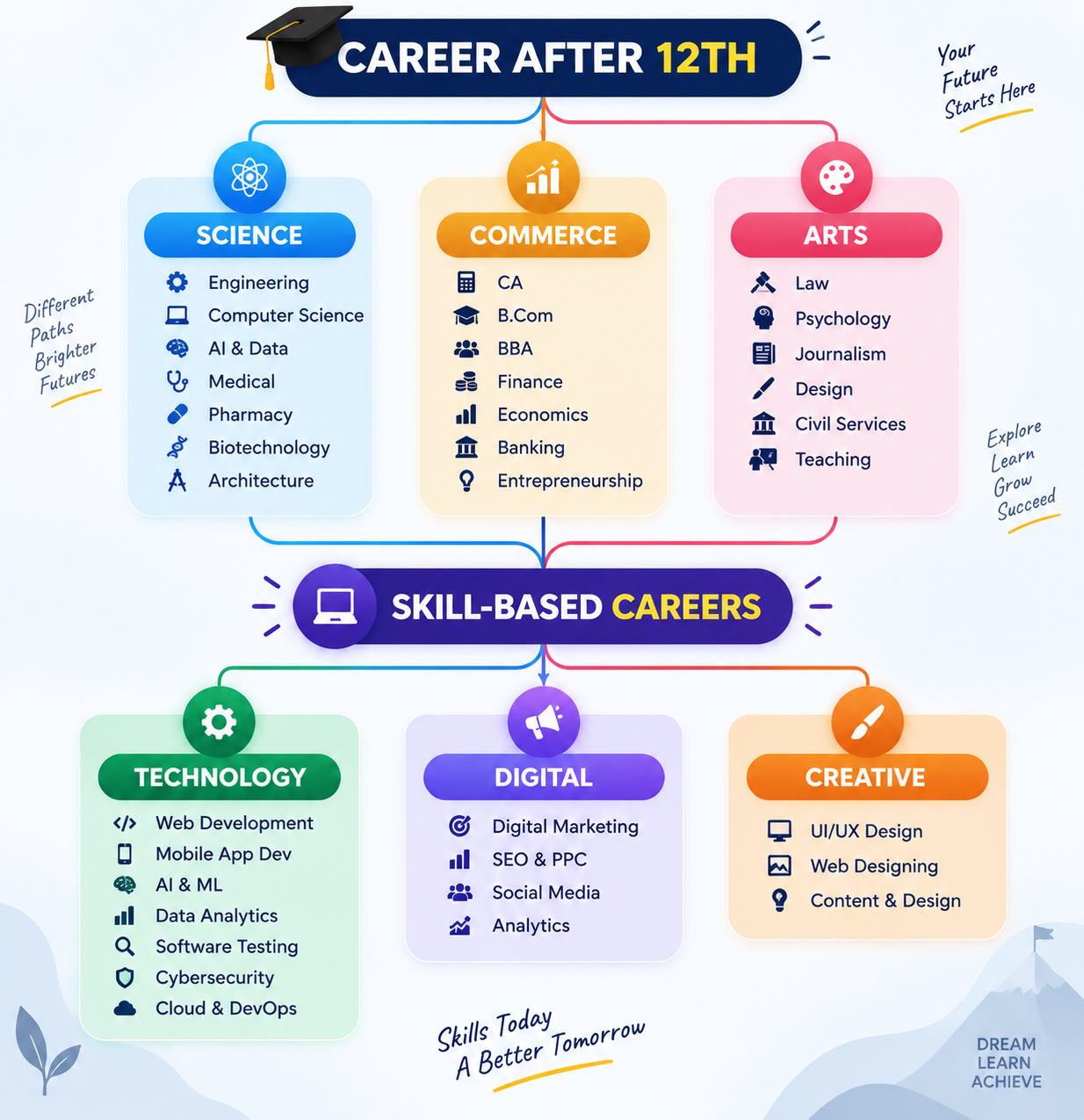 Notice that skill-based careers sit underneath all three traditional streams, meaning no matter which stream you’re in, technology and digital skills remain genuinely open to you.
Best Career Options After 12th Science
If you’re from a Science background, your options span engineering, computer science, AI & data science, medical and healthcare fields, pharmacy, biotechnology, architecture, cybersecurity, and various research careers. Each of these builds on the analytical and problem-solving foundation Science students already have.
Science students in particular tend to have a natural head start in technology-adjacent fields, since the same logical thinking that helps in physics or chemistry translates directly into programming, data analysis, and systems thinking. This is exactly why so many Science students end up pairing their core degree with a practical technology skill on the side, rather than treating the two as separate tracks.
Best for students who enjoy: Maths | Biology | Computers | Problem-solving | Research
Career Options After 12th Commerce
Commerce opens the door to Chartered Accountancy, B.Com, BBA, finance, banking, economics, Company Secretary, entrepreneurship, and increasingly, digital business roles that didn’t exist a decade ago.
What’s changed most for Commerce students in recent years is just how much overlap now exists between traditional business education and digital skills. A Commerce graduate who understands digital marketing analytics, for instance, brings a genuinely valuable combination to any business role: numbers plus the ability to actually act on what the data shows.
Student Tip: Commerce can lead to careers in finance, business, management, entrepreneurship, and even modern digital industries; it’s far more flexible than it’s often given credit for.
Career Options After 12th Arts: Discover Where Creativity & Ideas Can Take You
Arts students can explore law, psychology, journalism and mass communication, design, social work, political science, languages, civil services, and teaching and education.
Arts is also where some of the strongest creative-technology careers live. Students who pair an Arts background with skills like UI/UX design or content-focused digital marketing often find themselves genuinely more employable than peers who chose a “safer” stream but built no practical skill alongside it.
Arts doesn’t mean fewer career opportunities. The right combination of education, specialization, and practical skills can open multiple career paths, many of them just as competitive and rewarding as anything in Science or Commerce.
Want to Build Skills Instead of Just Collecting Degrees? Here’s Where to Start
This is where things get genuinely interesting for a lot of students. You don’t have to choose between academics and practical skills; you can build real, in-demand skills alongside your degree, and this is exactly where a shift in mindset pays off long-term.
Think of it this way: a degree tells an employer you completed a program. A genuine, demonstrable skill a working app you built, a website you designed, a campaign you actually ran tells them you can do the job. Increasingly, employers are weighting the second kind of proof far more heavily than the first, especially for entry-level roles in technology and digital fields.
- Technology: Web Development, Full-Stack Development, Mobile App Development, AI & Machine Learning, Data Analytics, Software Testing, Cybersecurity, Cloud & DevOps.
- Digital: Digital Marketing, SEO, PPC, Social Media Marketing, Analytics.
- Creative UI/UX Design, Web Designing, Figma, Digital Design.
These areas closely reflect the kind of practical training available through platforms like Skill Hives, including web development training, mobile app development, digital marketing course, AI/ML, and UI/UX built around real project experience and industry tools rather than pure classroom theory.
Ready to Explore a Skill-Based Path?
See which technology or digital skill actually fits you.
From Classroom Knowledge to Real-World Skills: Why Practical Learning Matters
The path that actually builds a career looks like this: Theory → Practice → Projects → Portfolio → Internship → Career. Skipping straight from theory to job applications, with nothing built in between, is exactly why so many graduates struggle to stand out despite having good grades.
This gap shows up most clearly at interview time. A candidate who can only recite what they learned in a textbook struggles the moment an interviewer asks, “Can you show me something you’ve actually built?” A candidate who has even one or two genuine projects, however small has a real, concrete answer, and that difference matters far more to most employers than an extra percentage point on a transcript.
This is precisely the gap Skill Hives is built to close, bridging theory and practice through live projects, hands-on practical sessions, expert mentorship, and genuine industry exposure, rather than stopping at conceptual knowledge alone.
Looking for Practical IT Skills? See What Skill Hives Offers
| Skill Area | What Students Can Explore |
|---|---|
| Web Development | Front-end, back-end, full-stack |
| Mobile App Development | Android, iOS, cross-platform |
| Digital Marketing | SEO, PPC, social media, analytics |
| AI & ML | Artificial intelligence and machine learning |
| UI/UX | User research, interface design, Figma |
| Web Designing | Website design and practical tools |
Skill Hives structures its programs around hands-on projects, industry mentorship, and practical exposure rather than focusing purely on theoretical learning. For students specifically curious about programming, a well-structured Python training program can be an excellent entry point into both web development and AI/ML paths. Students drawn more toward numbers and business insight often find a dedicated data analytics training track more aligned with their interests, while those fascinated by intelligent systems might explore a focused AI/ML course to go deeper into machine learning specifically.
Learn It. Build It. Practice It. The Skill-Based Career Approach
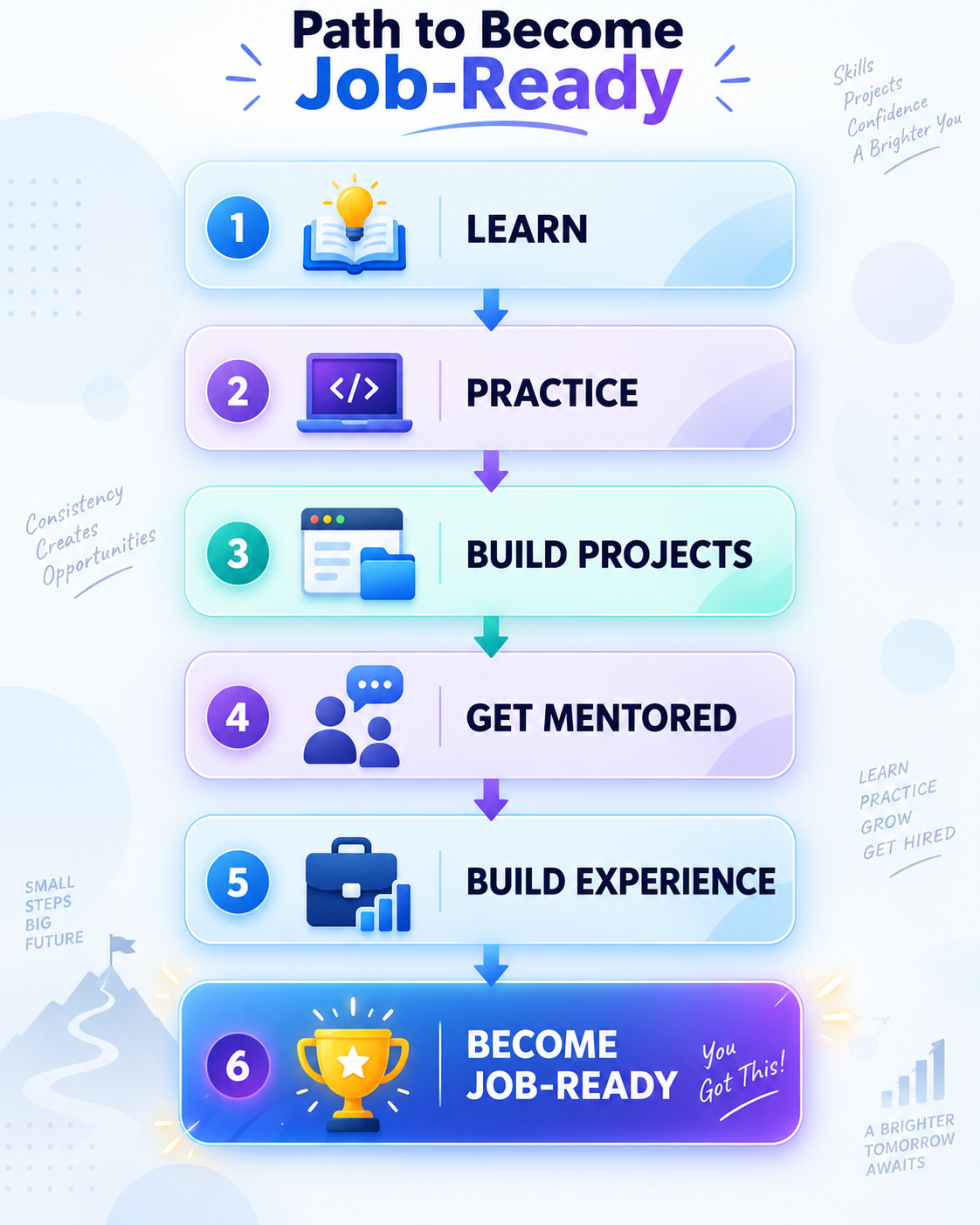 This cycle: not a single course completion certificate is what actually makes someone job-ready. Skill Hives’ approach leans heavily on live projects, practical sessions, one-to-one guidance, expert webinars, and collaborative learning, so students move through each stage of this cycle rather than stopping at “learn.”
Want to Learn Through Real Projects, Not Just Lectures?
Explore a genuinely practical training path.
How to Choose the Right Career After 12th?
Use this simple sequence: Interest → Strength → Skills → Course → Career Goal.
Ask yourself honestly: What subjects do I actually enjoy? What am I naturally good at? What kind of work genuinely interests me? What skills will I actually need to get there? What education or training is required? And importantly, can I gain real, practical experience in this field, or will I be stuck in theory for years before doing anything hands-on?
Notice that this sequence starts with you, not with what’s trending or what pays the most. A career chosen purely by following the highest salary numbers, without any genuine interest or aptitude behind it, tends to feel hollow within a few years, even if it looks impressive on paper.
Career After 12th: Which Path Sounds Like You?
| If You Like… | You Could Explore… |
|---|---|
| Maths + Technology | Engineering, AI, Data |
| Biology + Healthcare | Medical, Pharmacy, Nursing |
| Numbers + Business | CA, Finance, B.Com |
| Creativity | Design, UI/UX, Media |
| Communication | Law, Journalism, Marketing |
| Computers | Development, AI, Cybersecurity |
| Digital Business | Digital Marketing, SEO, Analytics |
If you’re someone who’s drawn to “Creativity” from this table, it’s worth knowing a structured web design course can turn that instinct into an actual, employable skill within months, not years.
Don’t Choose Your Career Just Because Someone Else Did
A few common mistakes worth avoiding entirely:
❌ Choosing because your friend chose it
❌ Choosing only because of salary
❌ Following family pressure without research
❌ Ignoring your own strengths
❌ Selecting a course without understanding it
❌ Focusing only on marks
❌ Ignoring practical skills
Your friend’s perfect career may not be your perfect career.
Still Confused? Use This Simple Career Formula
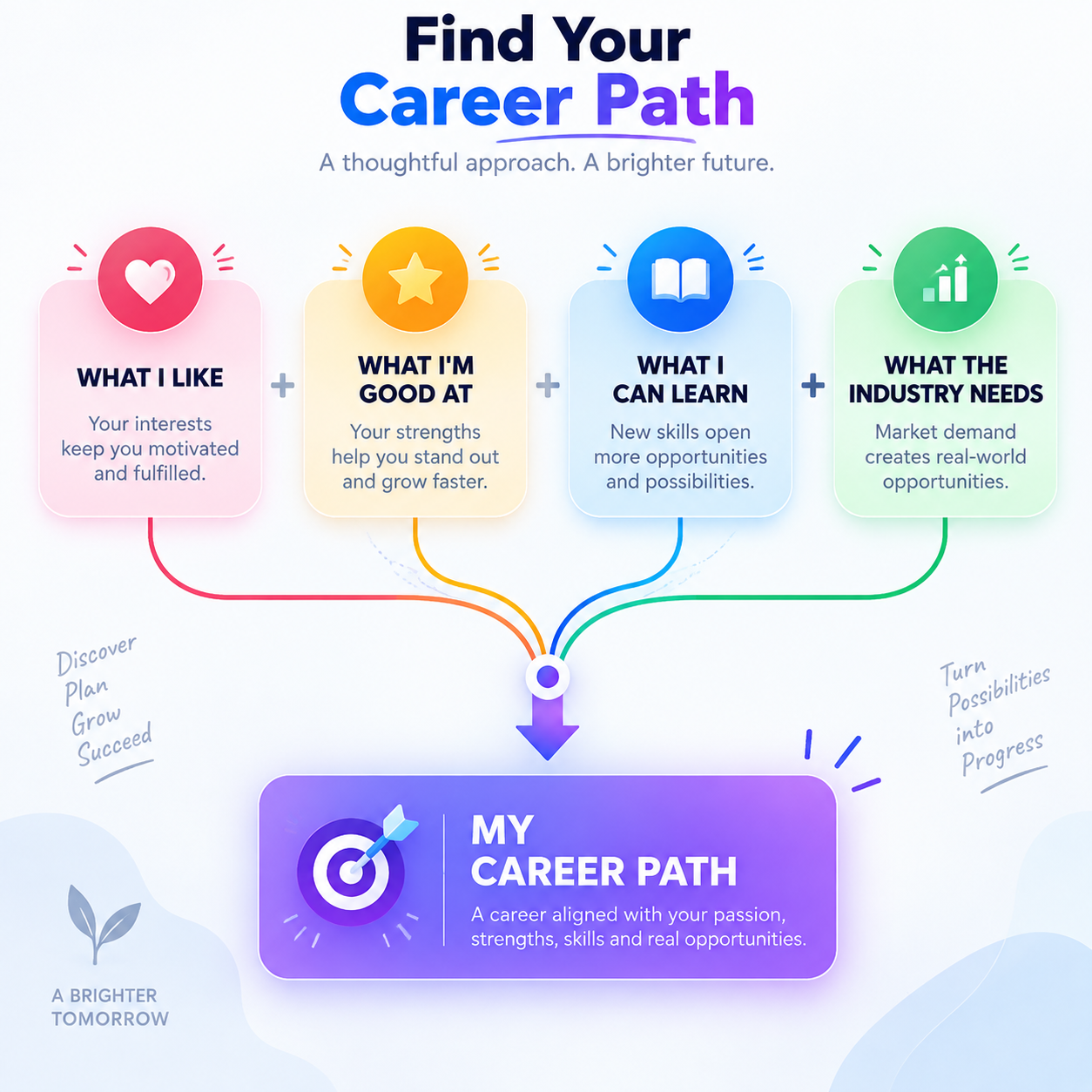 Run your own situation through this formula honestly, and you’ll usually land somewhere far more specific and far more genuinely yours than “whatever seems safe.”
Your Career Doesn’t Start After College. It Starts With What You Learn Today
Here’s the real takeaway for every Class 11 and 12 student reading this: explore before deciding, research before enrolling, and build skills alongside your academics rather than waiting until “later.” Work on real projects. Ask questions. Gain practical exposure wherever you can find it. And don’t be afraid to change direction once you learn more about yourself; that’s not failure, that’s the process working as it should.
If you’re specifically drawn toward practical IT and digital skills, whether that’s a focused Python training program, hands-on web development training, a creative web design course, or deeper data analytics training, Skill Hives is one option worth exploring as a best IT training company for students who want real, project-based learning. For students who want to go deeper before entering the job market, its 6-month industrial training track offers significantly more hands-on depth than a short course alone.
Still confused about your career after 12th? Start with your interests, explore the right career path, and build practical skills that can support your future with Skill Hives.
Ready to Turn Your Interests Into Real Skills?
Let’s figure out the right starting point together.
Frequently Asked Questions
What are the best career options after 12th in 2027?
The best options depend on your stream and interests, spanning traditional paths like engineering, medicine, CA, and law, alongside fast-growing skill-based careers in web development, AI/ML, digital marketing, and design.
What are the best career options after 12th science?
Science students can explore engineering, computer science, AI & data science, medical and healthcare fields, pharmacy, biotechnology, architecture, and cybersecurity.
What are the career options after 12th commerce?
Commerce students can pursue Chartered Accountancy, B.Com, BBA, finance, banking, economics, Company Secretary, entrepreneurship, and digital business roles.
What are the career options after 12th arts?
Arts students can explore law, psychology, journalism, design, social work, political science, languages, civil services, and teaching.
What can I do after 12th if I don’t want engineering or medicine?
Skill-based careers in technology (web development, AI/ML, data analytics), digital marketing (SEO, PPC, social media), and creative fields (UI/UX, web design) offer strong, practical alternatives that don’t require a traditional engineering or medical path.
Can I learn IT skills after 12th?
Yes, students can start learning practical IT skills like web development, digital marketing, or UI/UX design right after 12th, often alongside a degree, through platforms like Skill Hives that focus on hands-on, project-based training.
Recent Articles

QA Training in Chandigarh: Syllabus, Fees, Duration & Career Scope
Most Asked DSA Interview Questions and Answers for Freshers &…

Where to Get a UI UX Design Internship in Chandigarh…
Data Science Course in Chandigarh: Fees, Duration, Eligibility & Career…
What Is the Best Course After BCom? Top Career Options…

Devraj
 8th September 2026