September 2026 - Top IT Training Company in Chandigarh & Mohali - Skill Hives

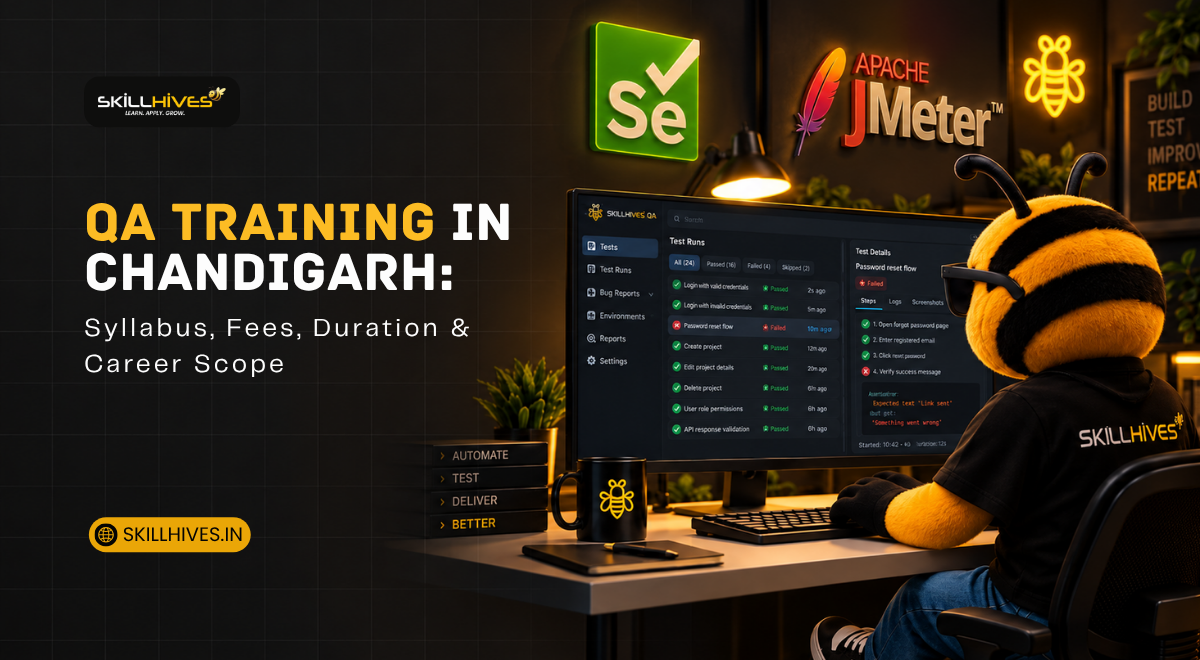
QA Training in Chandigarh: Syllabus, Fees, Duration & Career Scope

If you are looking for structured QA training in Chandigarh, this guide covers everything you need to know about top-rated quality assurance courses. Whether you want to start as a QA manual tester or are searching for a comprehensive quality checker course to build your software testing foundation, this guide breaks down the syllabus, duration, fees, and career paths available.

QA training is suitable for a wide range of learners:

  • Students and fresh graduates entering the IT industry
  • Beginners with no prior software testing experience
  • Working professionals changing careers into software quality
  • Developers who want to add testing skills to their profile
  • Manual testers who want to learn automation testing

Skill Hives offers QA and software testing training in Chandigarh and Mohali as part of its IT training programmes, practical, project-based, and designed for learners at different stages.

Accelerate Your QA Career with Skill Hives

Gain hands-on experience in manual testing, automation, API testing, and real-world projects.

Table of Content

What Is QA Training?Why Choose QA Training in Chandigarh?QA Training Course in Chandigarh: What Will You Learn?QA Training Syllabus in ChandigarhQA Training Duration in ChandigarhQA Training Fees in ChandigarhManual Testing vs Automation TestingWho Should Join QA Training?Skills You Can Develop Through QA TrainingTools Commonly Used in QA TestingQA Career Scope After TrainingHow to Choose the Right QA Training Institute in ChandigarhWhy Consider Skill Hives for QA Training in Chandigarh?QA Training Learning RoadmapHow to Start Your QA Career in ChandigarhQA Training in Chandigarh vs Self-LearningFrequently Asked QuestionsConclusion

What Is QA Training?

QA training is a structured programme that teaches students how to test software, identify defects, document issues, and help ensure applications work as expected. It covers the theory and practical skills that software testers use in real development environments.

Video introduction: What Is QA Testing? (YouTube)

Major areas covered in a QA training programme:

  • Software testing fundamentals and concepts
  • Manual testing methods and techniques
  • Test case and test scenario creation
  • Bug identification and reporting
  • Functional and non-functional testing
  • Regression testing and retesting
  • API testing basics
  • Automation testing introduction
  • Testing tools used in professional environments
  • Basic SQL and database testing concepts
  • Agile and Scrum methodologies
  • Real-world testing projects and practice

What Does a QA Tester Do?

A QA tester works through a defined workflow on every software product:

Requirement Analysis → Test Planning → Test Case Creation → Test Execution → Bug Reporting → Retesting → Regression Testing → Test Reporting

Each stage has a specific purpose. In requirement analysis, the tester reviews what the software should do. In test planning, they define the approach. Test case creation produces the specific scenarios to verify. Test execution runs those scenarios against the software. Bug reporting documents anything that doesn’t work as expected. Retesting confirms a fixed bug is resolved. Regression testing checks that fixes haven’t broken other features. Test reporting summarises the quality status to the team.

This workflow repeats across the development cycle and is what QA training prepares you to handle confidently.

Why Choose QA Training in Chandigarh?

Choosing a reliable software training institute in Chandigarh ensures you get a structured curriculum, practical lab sessions, and direct guidance from industry mentors rather than trying to learn complex concepts alone.

  • A guided curriculum that builds from fundamentals to advanced testing
  • Practical testing exercises on real or realistic software scenarios
  • Exposure to industry-standard testing tools
  • Both manual and automation testing concepts under one programme
  • Project-based practice that mirrors professional workflows
  • Interview preparation specific to QA and testing roles
  • Guidance for beginners who have never worked in software before
  • The opportunity to build testing skills applicable across different software products

No responsible training institute can promise guaranteed placement or specific salary outcomes. What a good QA training programme in Chandigarh can provide is a strong foundation, practical skills, and preparation that increases your readiness for entry-level testing roles.

QA Training Course in Chandigarh: What Will You Learn?

A comprehensive QA course gives you both the conceptual understanding and the hands-on skills that testing roles require. By the end of a full programme, you should be able to:

  • Understand how software is developed and where testing fits in the cycle
  • Write test cases and test scenarios from requirements
  • Execute tests manually and record results
  • Identify, document, and track defects through their lifecycle
  • Perform regression testing after code changes
  • Conduct basic API testing and understand request/response cycles
  • Query databases using basic SQL to validate data
  • Use test management and bug tracking tools used in professional environments
  • Understand automation testing concepts and when automation is appropriate
  • Work within Agile teams and understand the QA role in sprints
  • Complete an end-to-end project from requirements to final test report

QA Training Syllabus in Chandigarh

1. Introduction to Software Testing

  • What is software testing and why it matters
  • Quality Assurance vs Quality Control — the distinction
  • Verification vs Validation
  • Types of software testing (functional, non-functional, structural)
  • Software Development Life Cycle (SDLC) — where testing fits
  • Software Testing Life Cycle (STLC) — the tester’s process within a project

2. Manual Testing

  • Test scenarios — identifying what to test
  • Test cases — writing step-by-step verification instructions
  • Test data preparation
  • Test execution — running tests and recording outcomes
  • Functional testing — does the software do what it should?
  • Smoke testing — basic verification before deeper testing
  • Sanity testing — quick checks after minor changes
  • Regression testing — verifying existing features after updates
  • Retesting — confirming that reported bugs are fixed
  • Exploratory testing — unscripted discovery testing
  • Usability testing — evaluating the user experience

3. Bug and Defect Management

  • What is a bug and how it differs from an expected behaviour
  • Bug life cycle — from discovery to closure
  • Severity vs Priority — understanding the difference and why it matters
  • Writing effective bug reports — what information to include
  • Defect tracking — managing open bugs through to resolution

4. Test Documentation

  • Test plan — defining scope, approach, resources, and schedule
  • Test scenarios and test cases as formal documents
  • Test execution reports — recording what was tested and what happened
  • Requirement traceability matrix — mapping requirements to test coverage

5. API and Database Testing

  • What is an API and how applications communicate
  • HTTP request and response structure
  • API validation — testing endpoints, status codes, and responses
  • SQL basics — SELECT, WHERE, JOIN, and basic query structure
  • Database validation — verifying that data is stored and retrieved correctly

6. Automation Testing

  • What automation testing is and what it is not
  • When to automate — criteria for automation candidates
  • Identifying automation test cases from existing manual test cases
  • Test automation framework concepts — structure and purpose
  • Basic programming or scripting concepts relevant to automation
  • Overview of automation testing tools used in industry

7. Agile and Scrum Testing

  • Agile methodology — principles and how it differs from waterfall
  • Scrum framework — roles, ceremonies, and artefacts
  • Sprint — what happens in a testing sprint
  • User stories — reading and testing against acceptance criteria
  • The QA role in an Agile team — how testers contribute differently in Agile
  • Daily stand-ups — what testers report and why
  • Sprint testing — completing test cycles within sprint timeboxes

8. Practical QA Projects

The most valuable part of any QA programme is applying what you have learned to a realistic scenario.

A practical QA project follows the full tester workflow:

Requirement review → Test scenarios → Test cases → Execution → Bug reporting → Retesting → Final report

Students practise creating a complete test suite for a sample application, executing it, documenting results, raising bugs, retesting after fixes, and producing a summary report, the same output expected of a junior tester in a professional environment.

Start Your QA Training Journey

Practical, project-based QA and software testing training in Chandigarh and Mohali

QA Training Duration in Chandigarh

Whether you are looking for a 3-month skill course or a comprehensive 6-month industrial training program, choosing a structured path ensures hands-on experience on live projects.

Duration Suitable For What It Can Cover
3 Months Beginners and students seeking foundational training Testing fundamentals, manual testing, test cases, bug reporting, basic tools, and introductory automation
6 Months Learners seeking comprehensive training Manual and automation testing, API testing, SQL, Agile, tools, projects, and interview preparation
Customised Working professionals or learners with specific goals Selected modules based on prior experience, available time, and career objectives

Note: Actual course duration and curriculum can vary by institute and learner requirements. Contact Skill Hives directly for current programme details.

QA Training Fees in Chandigarh

QA training fees in Chandigarh vary depending on course duration, curriculum depth, practical training included, tools covered, project work, and whether the programme covers manual testing, automation, or both.

Course Type Typical Factors Affecting Fees
3-Month Training Course modules, practical sessions, and tools
6-Month Training Advanced topics, automation, projects, and additional modules
Customised Training Modules selected and total training duration

What Should You Check Before Comparing QA Training Fees?

Before making a decision based on price alone, evaluate:

  • Course duration and what is actually covered
  • Depth of the syllabus, fundamentals only, or manual and automation
  • Amount of practical testing sessions and project work
  • Testing tools included in the curriculum
  • Automation coverage and depth
  • Trainer’s actual software testing experience
  • Whether interview preparation is included
  • Certification details and what it represents
  • Batch size and learning format (classroom, online, or hybrid)

The cheapest option is rarely the most useful. The most relevant option is the one whose curriculum and practical coverage match your career goals.

Manual Testing vs Automation Testing

Factor Manual Testing Automation Testing
Testing Method Performed by a tester without scripts Performed using code or tools
Coding Requirement Usually low — logic and attention to detail matter more Requires programming or scripting knowledge
Repetitive Testing Time-consuming for large repetitive test sets Well-suited to regression and repeated scenarios
Learning Level Beginner-friendly Requires additional technical skills
Best Use Exploratory, usability, and new feature testing Regression, load, and repetitive test scenarios

Most professional QA roles in 2026 expect some degree of both. Manual testing skills are the foundation, automation testing becomes increasingly important as testers progress into senior or specialist roles. A comprehensive QA programme covers both so learners understand where each approach is appropriate.

Who Should Join QA Training?

QA training is suited to a genuinely broad range of learners:

  • Freshers & Graduates: Start your tech career by training as a QA manual tester.
  • Career Switchers: Enroll in a quality checker course to switch into software testing with zero prior coding experience
  • Graduates — adding a practical, employable skill to their degree
  • Beginners — interested in software quality with no prior IT background
  • Working professionals — changing careers from a different field
  • Manual testers — looking to add automation skills and advance
  • Developers — wanting to understand how their software gets tested

In addition to QA and software testing, cross-skilling in areas like web development training or basic programming helps QA professionals better understand application architecture and automated testing.

Do You Need Coding Skills for QA Training?

No, at least not to start. Manual testing does not require advanced programming knowledge. You need good analytical thinking, attention to detail, and an ability to think about software from a user’s perspective.

Programming skills become increasingly useful, and eventually necessary, when you move into automation testing. A good QA training programme introduces automation concepts in a way that is accessible to learners without a coding background, then builds from there.

Skills You Can Develop Through QA Training

  • Writing clear and effective test cases
  • Test execution and result recording
  • Bug identification and professional bug reporting
  • Requirement analysis and traceability
  • Problem-solving within testing scenarios
  • Attention to detail that catches defects others miss
  • Regression testing and retesting workflows
  • Basic API testing and request/response understanding
  • Database querying with SQL
  • Automation testing fundamentals
  • Agile testing within sprint-based development teams
  • Test documentation and reporting

Tools Commonly Used in QA Testing

Tool Category Purpose
Test Management Managing test cases, test plans, and execution records
Bug Tracking Reporting, tracking, and resolving defects through their lifecycle
API Testing Sending requests to API endpoints and validating responses
Automation Writing and running automated test scripts for repetitive scenarios
Database Tools Querying databases to validate stored and retrieved data
Version Control Managing testing files and scripts within a development team

Contact Skill Hives directly for the current tools covered in the QA programme curricula are updated as the industry evolves, and the current syllabus is the authoritative source.

Build Job-Ready QA Skills in Chandigarh

Manual testing, automation basics, API testing, tools, and real project practice

WhatsApp Us

QA Career Scope After Training

QA training can prepare learners for entry-level software testing roles and provide a foundation for progressing into specialised testing areas over time.

Typical career progression:

QA Trainee → QA Tester → Software Test Engineer → Automation Tester → Senior QA / Test Lead

Entry-level roles learners may be eligible for:

  • Manual Tester
  • QA Tester / QA Analyst
  • Software Test Engineer
  • QA Engineer
  • API Tester
  • Automation Tester (with additional automation skills)
  • Test Automation Engineer (with stronger programming background)

Software testing is a stable, in-demand field. Every software product needs QA, and as development teams grow, so do testing requirements. Learners who build both manual and automation skills position themselves for the strongest range of opportunities.

No training programme can promise specific salaries or guaranteed placement, these depend on individual skill development, interview performance, portfolio quality, and market conditions at the time of application.

How to Choose the Right QA Training Institute in Chandigarh

1. Syllabus

Check whether the curriculum covers both foundational testing concepts and practical application — not just theory.

2. Practical Training

Look for hands-on test case writing, real bug reporting exercises, and structured project work — not just concept delivery.

3. Automation Coverage

If automation is part of your career goal, confirm it is genuinely included and covers tools you will actually use.

4. Trainer Experience

Look for trainers with actual software testing experience in development environments — not just teaching backgrounds.

5. Projects

Ask specifically whether students work on realistic testing projects or only on isolated exercises.

6. Course Duration

Choose a programme length that matches your learning goals and availability — 3 months, 6 months, or customised.

7. Reviews

Check real, independently verifiable student reviews on Google or other platforms — not only the testimonials displayed by the institute itself.

Why Consider Skill Hives for QA Training in Chandigarh?

Skill Hives is a leading IT training company and the training division of Deftsoft in Mohali. We offer practical, project-based learning designed for students who want working knowledge, not just a certificate.

When evaluating Skill Hives for QA training, the key areas to check are:

  • The current QA course syllabus and whether it covers your goals
  • Practical learning — exercises, test cases, bug reporting, and projects
  • Course duration options — 3-month, 6-month, and customised
  • Tools covered in the current curriculum
  • Trainer background and how instruction is delivered
  • Certification provided on completion
  • Career preparation included in the programme

Looking for QA training in Chandigarh?

Check the current Skill Hives QA course curriculum and choose a learning plan based on your experience and career goals.

WhatsApp Us

QA Training Learning Roadmap

Step 1: Testing Fundamentals

Step 2: Manual Testing

Step 3: Test Cases & Bug Reporting

Step 4: API & Database Testing

Step 5: Automation Testing

Step 6: Practical Project

Step 7: Interview Preparation

Each step builds on the previous one. Skipping foundational manual testing and jumping to automation is one of the most common mistakes beginners make, automation without testing fundamentals produces poor quality scripts and shaky understanding. For candidates moving into technical testing or automation engineering roles, preparing for common DSA interview questions (Data Structures and Algorithms) helps build strong logic for script optimization and technical round clears.

How to Start Your QA Career in Chandigarh

  1. Understand software testing fundamentals — what it is, why it matters, and how it fits into development
  2. Choose a structured QA training programme that covers both manual and automation
  3. Learn manual testing — test cases, execution, and defect reporting
  4. Practice writing test cases for different types of applications
  5. Learn defect reporting — what makes a bug report useful to a developer
  6. Add API and database testing skills to your foundation
  7. Study automation testing concepts and at least one automation tool
  8. Complete practical projects — end-to-end testing from requirements to report
  9. Prepare specifically for QA interviews — practice explaining your process
  10. Apply for entry-level testing roles with a portfolio of your project work

QA Training in Chandigarh vs Self-Learning

Factor QA Training Self-Learning
Learning Structure Guided curriculum with defined progression You define your own path and sequence
Trainer Support Available — questions get answered by someone with experience Usually limited to forums and comments
Practical Guidance Structured exercises, projects, and feedback Depends entirely on the learner’s initiative
Flexibility Based on batch schedule and course format Highly flexible — learn at your own pace
Learning Resources Course materials and tools provided Must find and evaluate resources independently
Accountability Regular classes, tasks, and check-ins Self-managed — easy to drift or skip topics

Self-learning works well for motivated, experienced learners who already have some context. For students and beginners entering software testing without a background in IT, a structured programme reduces the risk of learning the wrong things in the wrong order — which is a real cost in both time and confusion.

Frequently Asked Questions

What is QA training?

QA training teaches learners how to test software, identify defects, write test cases, report bugs, perform different types of testing, and understand software quality processes. A complete programme covers manual testing, automation concepts, tools, and practical project work.

How long does QA training take in Chandigarh?

QA training duration depends on the course and learning goals. Common options are 3 months for foundational training, 6 months for a more comprehensive programme covering automation, and customised durations for learners with specific requirements.

What is included in a QA training syllabus?

A QA syllabus typically includes software testing fundamentals, manual testing, test case and scenario writing, bug reporting, regression testing, API testing, basic SQL and database testing, automation testing concepts, Agile testing, industry tools, and practical projects.

Can beginners join QA training without coding knowledge?

Yes. Manual testing does not require programming skills. Beginners can start with testing fundamentals and manual testing methods. Programming knowledge becomes more relevant when moving into automation testing, which is usually introduced later in the programme.

What is the difference between manual and automation testing?

Manual testing is performed by a tester executing test cases without automated scripts — used for exploratory, usability, and new feature testing. Automation testing uses tools and scripts to execute repetitive test cases automatically — particularly useful for regression testing at scale.

What career opportunities are available after QA training?

Depending on skills, projects completed, and interview performance, learners can pursue entry-level roles including QA Tester, Manual Tester, Software Test Engineer, QA Analyst, Automation Tester, and QA Engineer. Career progression typically moves from junior tester to experienced engineer to senior or specialist roles.

Conclusion

QA is a structured, practical field. The software industry relies on testing professionals to catch defects, protect users, and ensure quality before products reach production. A well-structured QA training programme in Chandigarh gives you the fundamentals, the tools, the project experience, and the interview preparation to enter this field with genuine capability.

Whether you are a student, a career switcher, or a professional adding a new skill, the key is choosing a programme with the right syllabus, real practical work, and honest, experienced instruction.

Skill Hives offers QA training in Chandigarh and Mohali with practical, project-based learning for learners at all levels.
Most Asked DSA Interview Questions and Answers for Freshers & Experienced

Preparing for a technical interview can feel challenging, especially when you are not sure which DSA interview questions to practice first. Data Structures and Algorithms (DSA) are among the most common topics asked in software development and technical interviews, from fresher-level roles to experienced developer positions.

The good news is that you don’t need to memorize hundreds of solutions. You need to understand the right concepts, problem-solving patterns, data structures, algorithms, and time and space complexity.

This guide covers the 100 most asked DSA interview questions and answers for freshers and experienced candidates, including arrays, strings, linked lists, stacks, queues, trees, graphs, hashing, sorting, searching, dynamic programming, and more. Each question includes a simple explanation, example, complexity, or interview tip to make preparation easier.

Whether you are preparing for your first coding interview or targeting an experienced developer role, this list can help you revise important DSA concepts and practice the problem-solving approach interviewers expect.

100 Most Asked DSA Interview Questions and Answers

Part 1: Basic DSA Interview Questions

These questions are particularly useful for freshers, interns, junior developers, and candidates with 0–2 years of experience.

1. What is DSA?

Answer: DSA stands for Data Structures and Algorithms. Data structures organize and store data efficiently, while algorithms define the steps used to process that data and solve a problem.

Interview tip: Explain DSA together rather than treating them as completely separate concepts.

2. What is a data structure?

Answer: A data structure is a way of organizing and storing data so that operations such as insertion, deletion, searching, and retrieval can be performed efficiently.

Examples: Array, linked list, stack, queue, tree, graph, heap, and hash table.

Complexity: Depends on the structure.

Follow-up: How would you choose a data structure for a problem?

3. What are the main types of data structures?

Answer: Data structures are commonly divided into:

  • Linear: arrays, linked lists, stacks, queues
  • Non-linear: trees, graphs
  • Hash-based: hash tables/maps
  • Specialized: heaps, tries, union-find

They can also be classified as static or dynamic depending on how memory changes.

Interview tip: Be ready to explain why a particular structure is appropriate for a particular operation.

4. What is an array?

Answer: An array stores elements in contiguous memory locations and generally provides constant-time access by index.

Example: arr[3] directly accesses the fourth element.

Complexity:

  • Access: O(1)
  • Search: O(n) unsorted
  • Insert/delete at middle: O(n)

Interview tip: Mention that arrays provide excellent cache locality.

5. Array vs linked list — what is the difference?

Array Linked List
Contiguous memory Nodes can be scattered
O(1) indexed access O(n) access
Insertion may require shifting Easy insertion after known node
Better cache locality Extra pointer memory

Example: Arrays suit indexed records; linked lists can suit frequently changing sequences.

Interview tip: Never say linked lists are simply “better for insertion.” Finding the insertion location may still take O(n).

6. What is a linked list?

Answer: A linked list is a sequence of nodes where each node stores data and a reference to another node.

Types: Singly, doubly, and circular linked lists.

Example: A playlist where each song points to the next song.

Complexity:

  • Access: O(n)
  • Search: O(n)
  • Insert at head: O(1)
  • Delete known node: O(1)

7. What is a stack?

Answer: A stack is a LIFO (Last In, First Out) data structure.

Operations: Push, pop, peek/top.

Example: Browser back history, undo functionality, function call stack.

Complexity: Push/pop/peek are normally O(1).

Follow-up: How can you implement a stack using an array or linked list?

8. What is a queue?

Answer: A queue follows FIFO (First In, First Out).

Operations: Enqueue and dequeue.

Example: Print jobs waiting for a printer.

Complexity: O(1) with a suitable implementation such as a linked list or circular queue.

Follow-up: What is the difference between a queue and a deque?

9. What is a circular queue?

Answer: A circular queue connects the end of the queue back to its beginning so previously freed positions can be reused.

Example: CPU scheduling or a fixed-size network buffer.

Complexity: Enqueue and dequeue are O(1).

Interview tip: Know how the front and rear pointers wrap around.

10. What is a deque?

Answer: A deque, or double-ended queue, allows insertion and deletion from both ends.

Example: A task scheduler may add urgent tasks at one end and regular tasks at another.

Complexity: O(1) for end operations with an appropriate implementation.

Follow-up: How can a deque implement both stack and queue behavior?

11. What is a hash table?

Answer: A hash table stores key-value pairs and uses a hash function to determine where values should be stored.

Example: {userID → userProfile}.

Average complexity:

  • Search: O(1)
  • Insert: O(1)
  • Delete: O(1)

Worst case can reach O(n).

Interview tip: Understand collisions.

12. What is a hash collision?

Answer: A collision occurs when two different keys produce the same hash-table location.

Common solutions:

  • Separate chaining
  • Open addressing

Example: Multiple usernames hashing to the same bucket.

Complexity: Average operations remain O(1) with a good hash function and controlled load factor.

13. What is recursion?

Answer: Recursion occurs when a function calls itself to solve smaller instances of the same problem.

Every recursive solution should have:

  1. Base case
  2. Recursive case

Example: Factorial.

factorial(n) = n × factorial(n-1)

Complexity: Factorial takes O(n) time and O(n) call-stack space.

Interview tip: Always identify the base case first.

14. What is Big O notation?

Answer: Big O describes how an algorithm’s resource usage grows as input size increases.

Common complexities:

O(1) < O(log n) < O(n) < O(n log n) < O(n²) < O(2ⁿ)

Example: Searching a sorted million-item dataset using binary search instead of linear search.

Interview tip: Interviewers frequently ask you to optimize an O(n²) solution.

15. What is the difference between time and space complexity?

Answer: Time complexity estimates how running time grows with input size. Space complexity estimates additional memory requirements.

Example: Merge sort:

  • Time: O(n log n)
  • Auxiliary space: O(n)

Follow-up: Can you improve space without increasing time?

16. What is linear search?

Answer: Linear search checks elements sequentially until the target is found.

for each element:

if element == target:

return index

Complexity: O(n) time, O(1) space.

Example: Searching an unsorted list of employee IDs.

17. What is binary search?

Answer: Binary search repeatedly divides a sorted search space into two halves.

Example: Searching for 73 in a sorted array.

Complexity: O(log n) time, O(1) iterative space.

Interview tip: Mention that the input must satisfy the ordering condition.

18. What is the difference between linear and binary search?

Linear Search Binary Search
O(n) O(log n)
Works on unsorted data Usually requires sorted data
Simple Requires careful boundaries

Follow-up: Can binary search be used without an explicitly sorted array?

Answer: Yes, when searching a monotonic answer space.

19. What is sorting?

Answer: Sorting arranges elements according to a chosen order.

Common algorithms include:

  • Bubble sort
  • Selection sort
  • Insertion sort
  • Merge sort
  • Quick sort
  • Heap sort

Example: Sorting products by price.

20. What is bubble sort?

Answer: Bubble sort repeatedly compares adjacent elements and swaps them if they are in the wrong order.

Complexity: O(n²) average/worst case; O(n) best case with an optimization.

Space: O(1).

Interview tip: Know why bubble sort is rarely preferred in production.

21. What is insertion sort?

Answer: Insertion sort builds the sorted portion one element at a time.

Best case: O(n)

Average/worst: O(n²)

Space: O(1)

Example: Sorting a small hand of playing cards.

22. What is selection sort?

Answer: Selection sort repeatedly finds the minimum element from the unsorted section and places it at the correct position.

Time: O(n²)

Space: O(1)

Interview tip: Its number of swaps can be lower than some simple sorting methods.

23. What is a stable sorting algorithm?

Answer: A stable sort preserves the relative order of equal-valued elements.

Examples: Merge sort and insertion sort are commonly stable.

Example: Sorting employees by department while preserving their previous salary ordering.

Follow-up: Is quicksort always stable? No.

24. What is a binary tree?

Answer: A binary tree is a tree in which each node has at most two children: left and right.

Example: Expression trees and hierarchical decision structures.

Complexity: Traversing all nodes takes O(n).

25. What is a Binary Search Tree?

Answer: A BST is a binary tree where values in the left subtree are smaller and values in the right subtree are larger, assuming the chosen duplicate policy.

Average search: O(log n)

Worst case: O(n)

Interview tip: A skewed BST behaves like a linked list.

26. What is tree traversal?

Answer: Traversal means visiting all nodes according to a specific order.

Main methods:

  • Preorder
  • Inorder
  • Postorder
  • Level order

Example: Processing hierarchical folders.

27. What is inorder traversal?

Answer: Inorder traversal visits:

Left → Root → Right

For a valid BST, inorder traversal produces sorted values.

Complexity: O(n) time and O(h) recursion/stack space.

28. What is preorder traversal?

Answer: Preorder visits:

Root → Left → Right

Use case: Serializing or copying tree structures.

Complexity: O(n).

29. What is postorder traversal?

Answer: Postorder visits:

Left → Right → Root

Use case: Deleting a tree or evaluating expression trees.

Complexity: O(n).

30. What is BFS?

Answer: Breadth-First Search explores nodes level by level, normally using a queue.

Complexity: O(V + E) for an adjacency-list graph.

Example: Finding the shortest number of connections in an unweighted social network.

31. What is DFS?

Answer: Depth-First Search explores as far as possible along one branch before backtracking.

It can be implemented using recursion or an explicit stack.

Complexity: O(V + E).

Example: Exploring connected components in a network.

32. BFS vs DFS?

BFS DFS
Queue Stack/recursion
Level by level Depth first
Good for unweighted shortest paths Good for exhaustive exploration
Can use more memory on wide graphs Can use more stack on deep graphs

33. What is a graph?

Answer: A graph consists of vertices/nodes and edges connecting them.

Graphs can be:

  • Directed/undirected
  • Weighted/unweighted
  • Cyclic/acyclic

Example: Cities connected by roads.

Complexity: Depends on representation and operation.

34. What is an adjacency list?

Answer: An adjacency list stores the neighbors of every vertex.

Space: O(V + E)

It is usually preferable for sparse graphs.

Example: A social network where each person has a list of connections.

34. What is an adjacency list?

Answer: An adjacency list stores the neighbors of every vertex.

Space: O(V + E)

It is usually preferable for sparse graphs.

Example: A social network where each person has a list of connections.

Part 2: Intermediate DSA Interview Questions

These questions focus more on problem solving, optimization, implementation, and recognizing interview patterns.

35. How do you reverse an array?

Answer: Use two pointers, one at each end, and swap until they meet.

left = 0
right = n - 1

while left < right:
    swap(arr[left], arr[right])
    left++
    right--

Time: O(n)

Space: O(1)

Pattern: Two pointers.

36. How do you find the largest and smallest element in an array?

Answer: Scan the array once while maintaining minimum and maximum values.

Time: O(n)

Space: O(1)

Example: Finding the highest and lowest transaction amounts.

Follow-up: Can you find the second-largest element in one pass?

37. How do you remove duplicates from a sorted array?

Answer: Use a slow pointer to maintain the position of the next unique element while a fast pointer scans the array.

Time: O(n)

Space: O(1)

Pattern: Two pointers.

38. How do you solve the Two Sum problem?

Answer: Store previously seen values in a hash map. For each number x, check whether target – x has already been seen.

Time: O(n) average

Space: O(n)

Example: [2,7,11,15], target 9 → 2 + 7.

Follow-up: What if the array is already sorted? Use two pointers with O(1) extra space.

39. What is the sliding-window technique?

Answer: Sliding window maintains a moving range over an array or string instead of repeatedly processing overlapping elements.

Example: Find the maximum sum of any subarray of size k.

Time: Usually O(n)

Space: Often O(1), depending on the problem.

Example: Calculating a rolling average of website traffic.

40. What are two pointers?

Answer: Two pointers use two indexes that move through a data structure to avoid unnecessary nested loops.

Example: Finding whether a sorted array contains two numbers with a target sum.

Time: O(n)

Space: O(1)

Interview tip: Ask whether the data is sorted before choosing this approach.

41. How do you check whether a string is a palindrome?

Answer: Compare characters from both ends while moving toward the center.

Time: O(n)

Space: O(1)

Example: “racecar” is a palindrome.

Follow-up: How would you handle spaces and uppercase letters?

42. How do you find the first non-repeating character?

Answer: Count character frequencies with a hash map, then scan the string again for the first character with frequency one.

Time: O(n)

Space: O(k), where k is the character set size.

Example: Finding the first unique character in a username.

43. How do you check whether two strings are anagrams?

Answer: Count the frequency of each character in both strings and compare the counts.

Time: O(n)

Space: O(k)

Example: “listen” and “silent” are anagrams.

44. How do you reverse a linked list?

Answer: Maintain prev, current, and next pointers and reverse each link.

prev = null
current = head

while current:
    next = current.next
    current.next = prev
    prev = current
    current = next

Time: O(n)

Space: O(1)

Follow-up: Implement it recursively.

45. How do you detect a cycle in a linked list?

Answer: Use Floyd’s slow and fast pointer algorithm.

  • Slow moves one step.
  • Fast moves two steps.
  • If they meet, a cycle exists.

Time: O(n)

Space: O(1)

Example: Detecting an unintended circular reference in a linked data structure.

46. How do you find the middle of a linked list?

Answer: Move one pointer one step and another two steps. When the fast pointer reaches the end, the slow pointer is at the middle.

Time: O(n)

Space: O(1)

Pattern: Fast and slow pointers.

47. How do you merge two sorted linked lists?

Answer: Compare the current nodes of both lists and repeatedly attach the smaller node.

Time: O(n + m)

Space: O(1) extra space if nodes are reused.

Example: Merging sorted streams of records.

48. How do you implement a stack using queues?

Answer: One common method rearranges queue elements after each push so the newest element appears at the front.

Push: O(n)

Pop: O(1)

Alternative designs can trade the complexities.

Interview tip: Explain the trade-off rather than presenting only one implementation.

49. How do you implement a queue using stacks?

Answer: Use two stacks:

  • Input stack for enqueue
  • Output stack for dequeue

Transfer elements only when the output stack is empty.

Amortized complexity: O(1) per operation.

Space: O(n).

50. What is a priority queue?

Answer: A priority queue removes the element with the highest or lowest priority rather than simply following insertion order.

A heap is commonly used to implement it.

Complexity with binary heap:

  • Insert: O(log n)
  • Remove: O(log n)
  • Peek: O(1)

Example: CPU task scheduling.

51. What is a heap?

Answer: A heap is a complete binary tree satisfying a heap-order property.

  • Min heap: parent ≤ children
  • Max heap: parent ≥ children

Typical representation: Array.

Build heap: O(n)

52. How do you find the K largest elements?

Answer: Maintain a min-heap of size k.

For each element:

  • Add it.
  • If heap size exceeds k, remove the smallest.

Time: O(n log k)

Space: O(k)

Example: Finding the top 10 products by sales.

53. What is merge sort?

Answer: Merge sort divides an array into halves, recursively sorts each half, and merges them.

Time: O(n log n)

Space: O(n)

Advantage: Predictable performance and stable sorting.

Example: Sorting large datasets where predictable performance matters.

54. What is quicksort?

Answer: Quicksort selects a pivot, partitions the elements around it, and recursively sorts the partitions.

Average: O(n log n)

Worst: O(n²)

Typical stack: O(log n) average.

Interview tip: Explain pivot selection and worst-case behavior.

55. Merge sort vs quicksort?

Merge Sort Quick Sort
O(n log n) worst-case O(n²) worst-case
O(n) auxiliary array space Usually in-place
Stable in standard form Usually not stable
Predictable Often fast in practice

56. What is a hash map’s load factor?

Answer: Load factor is approximately:

number of stored entries / number of buckets

When the load factor becomes too high, hash-table implementations may resize and rehash.

Interview tip: Understand why resizing helps maintain average O(1) operations.

57. What is memoization?

Answer: Memoization stores results of previously solved subproblems so they don’t have to be recalculated.

Example: Recursive Fibonacci.

Without memoization, Fibonacci has exponential repeated work. With memoization, it becomes O(n).

Space: O(n).

58. What is dynamic programming?

Answer: Dynamic programming solves problems with overlapping subproblems and optimal substructure by storing previously computed results.

Two common approaches:

  • Top-down memoization
  • Bottom-up tabulation

Example: Budget optimization and resource allocation.

59. What is the difference between recursion and dynamic programming?

Answer: Recursion describes how a problem is broken into smaller problems. DP adds reuse of repeated subproblem results.

Example: Recursive Fibonacci is inefficient because it recomputes values; DP stores them.

60. What is Kadane’s algorithm?

Answer: Kadane’s algorithm finds the maximum-sum contiguous subarray.

For each element, decide whether to:

  • Extend the current subarray
  • Start a new subarray

Time: O(n)

Space: O(1)

Example: [-2,1,-3,4,-1,2,1,-5,4] → maximum sum is 6.

61. How do you merge overlapping intervals?

Answer: Sort intervals by start time, then compare each interval with the end of the last merged interval.

Time: O(n log n) due to sorting.

Space: O(n) for output.

Example: Combining overlapping employee meeting schedules.

62. What is a monotonic stack?

Answer: A monotonic stack maintains elements in increasing or decreasing order to efficiently answer next-greater/next-smaller type questions.

Example: Next Greater Element.

Time: O(n), because each element is pushed and popped at most once.

Example: Stock-price or temperature trend analysis.

63. How do you solve the Valid Parentheses problem?

Answer: Push opening brackets onto a stack. For a closing bracket, check whether it matches the top opening bracket.

Time: O(n)

Space: O(n)

Example: “({[]})” → valid.

Follow-up: How would you support additional bracket types?

64. How do you find the intersection of two arrays?

Answer: Use a hash set to store elements from one array, then check the second array.

Time: O(n + m) average

Space: O(n)

If arrays are sorted, two pointers can achieve O(n + m) with less extra space.

65. How do you find a missing number from 1 to n?

Answer: Use the mathematical sum or XOR technique.

For XOR:

1 ^ 2 ^ ... ^ n ^ array elements

The duplicates cancel, leaving the missing value.

Time: O(n)

Space: O(1)

66. What is a trie?

Answer: A trie is a tree-like structure used to store strings character by character.

Operations: Insert, search, prefix search.

Time: O(L), where L is the word length.

Example: Autocomplete and dictionary applications.

67. What is a graph’s adjacency matrix?

Answer: An adjacency matrix uses a V × V matrix to indicate whether an edge exists between two vertices.

Space: O(V²)

Advantage: O(1) edge lookup.

Disadvantage: Wasteful for sparse graphs.

68. Adjacency list vs adjacency matrix?

Adjacency List Adjacency Matrix
O(V+E) space O(V²) space
Good for sparse graphs Good for dense graphs
Neighbor traversal efficient Edge lookup O(1)

Part 3: Advanced DSA Interview Questions

These questions are particularly useful for experienced developers, senior engineers, product-company interviews, and candidates targeting harder technical rounds.

69. What is Dijkstra’s algorithm?

Answer: Dijkstra’s algorithm finds shortest paths from a source vertex to other vertices in a graph with non-negative edge weights.

With a binary heap and adjacency list:

Time: O((V + E) log V)

Example: Finding the shortest road route.

Important: It does not correctly handle negative edge weights.

70. Dijkstra vs Bellman-Ford?

Dijkstra Bellman-Ford
No negative edges Supports negative edges
Faster generally Slower
Cannot detect negative cycles Can detect negative cycles

Bellman-Ford: O(VE)

71. What is the Floyd-Warshall algorithm?

Answer: Floyd-Warshall finds shortest paths between every pair of vertices.

Time: O(V³)

Space: O(V²)

It can handle negative edges but not negative cycles meaningfully for shortest-path output.

Use case: Dense graphs and all-pairs shortest-path problems.

72. What is topological sorting?

Answer: Topological sorting orders vertices in a directed acyclic graph (DAG) so every directed edge u → v places u before v.

Methods:

  • DFS
  • Kahn’s algorithm using indegrees

Time: O(V + E)

Example: Scheduling courses based on prerequisites.

73. How do you detect a cycle in a directed graph?

Answer: DFS can track nodes currently in the recursion stack. Encountering a node already in that stack indicates a cycle.

Alternatively, Kahn’s algorithm can detect a cycle if fewer than V nodes can be processed.

Time: O(V + E)

74. How do you detect a cycle in an undirected graph?

Answer: During DFS, track the parent of each node. If you encounter an already visited neighbor that is not the parent, a cycle exists.

Another approach is Union-Find.

Time: O(V + E) using DFS.

75. What is Union-Find / Disjoint Set Union?

Answer: DSU maintains a collection of disjoint sets and supports:

  • Find
  • Union

With path compression and union by rank/size, operations are nearly constant amortized time:

O(α(n))

Example: Network connectivity and grouping components.

76. What is Kruskal’s algorithm?

Answer: Kruskal’s algorithm constructs a minimum spanning tree by sorting edges by weight and adding an edge if it does not create a cycle.

It commonly uses Union-Find.

Time: O(E log E)

Example: Designing a low-cost network connecting multiple locations.

77. What is Prim’s algorithm?

Answer: Prim’s algorithm grows a minimum spanning tree by repeatedly selecting the cheapest edge connecting the current tree to an unvisited vertex.

Using a binary heap:

Time: O(E log V)

Follow-up: Compare Prim’s and Kruskal’s algorithms.

78. What is a minimum spanning tree?

Answer: An MST connects all vertices of a connected, weighted, undirected graph with minimum possible total edge weight and no cycles.

Applications: Network, road, and cable design.

Algorithms: Prim and Kruskal.

79. What is the 0/1 Knapsack problem?

Answer: Given items with weights and values, maximize total value without exceeding capacity, where each item can be selected at most once.

Typical DP:

dp[i][w] = maximum value using first i items with capacity w

Time: O(nW)

Space: O(nW), reducible to O(W).

Interview tip: Explain why greedy does not generally solve 0/1 knapsack optimally.

80. What is the Longest Common Subsequence problem?

Answer: LCS finds the longest sequence that appears in two strings in the same relative order, not necessarily contiguously.

Example:

ABCBDAB and BDCABA

LCS length is 4.

Time: O(nm)

Space: O(nm), reducible for length-only computation.

81. What is the Longest Increasing Subsequence?

Answer: LIS finds the longest subsequence whose values are strictly increasing.

A classic optimized solution uses binary search over maintained tails.

Time: O(n log n)

Space: O(n)

Interview tip: Understand the difference between a subsequence and a subarray.

82. What is backtracking?

Answer: Backtracking builds a solution incrementally and abandons a partial solution when it cannot lead to a valid answer.

Common problems:

  • N-Queens
  • Sudoku
  • Permutations
  • Combinations
  • Subsets

Complexity: Usually exponential.

Example: Constraint-based scheduling or configuration search.

83. How do you solve the N-Queens problem?

Answer: Place one queen per row while tracking occupied columns and diagonals. If a placement creates a conflict, backtrack.

Typical complexity: O(N!) upper-bound style analysis, with pruning improving practical performance.

Space: O(N) auxiliary tracking plus recursion.

84. How do you generate all permutations?

Answer: Use backtracking. At each position, choose an unused element, recurse, and then undo the choice.

For n unique elements:

Time: O(n × n!) to output all permutations.

Space: O(n) recursion excluding output.

85. How do you generate all subsets?

Answer: For each element, make two choices:

  1. Include it.
  2. Exclude it.

There are 2ⁿ subsets.

Time: O(n × 2ⁿ) if explicitly constructing each subset.

Space: O(n) auxiliary recursion excluding output.

86. What is the difference between greedy algorithms and dynamic programming?

Greedy algorithms make the best local decision at each step and never revisit it.

DP evaluates and stores solutions to subproblems.

Example:

  • Fractional knapsack → greedy works.
  • 0/1 knapsack → DP is generally required.

Interview tip: Never assume a greedy solution is optimal without proving the greedy-choice property.

87. What is the Activity Selection problem?

Answer: Select the maximum number of non-overlapping activities.

Sort activities by finishing time and repeatedly choose the next compatible activity.

Time: O(n log n) including sorting.

Space: O(1) auxiliary depending on implementation.

Pattern: Greedy.

88. What is binary search on the answer?

Answer: Instead of searching an array for a value, binary search is performed over a numerical answer range when the feasibility condition is monotonic.

Example: Find the minimum shipping capacity needed to deliver packages within D days.

Complexity: Usually O(n log R), where R is the answer range.

89. What is the “Merge K Sorted Lists” problem?

Answer: Use a min-heap containing the smallest current node from each list. Remove the minimum and insert the next node from that list.

Time: O(N log k)

Space: O(k)

where N is the total number of nodes and k is the number of lists.

Example: Merging sorted database or log streams.

90. How do you find the median from a data stream?

Answer: Use two heaps:

  • Max-heap for the smaller half.
  • Min-heap for the larger half.

Keep their sizes balanced.

Insertion: O(log n)

Median: O(1)

Example: Tracking a live median of transaction values.

91. What is an LRU cache?

Answer: LRU means Least Recently Used. When the cache is full, the least recently accessed item is removed.

A standard O(1) design combines:

  • Hash map
  • Doubly linked list

Get: O(1) average

Put: O(1) average

Space: O(capacity)

This is one of the classic questions where the interviewer tests whether you can combine two data structures.

92. What is the difference between a B-tree and B+ tree?

Answer: Both are balanced multiway search trees commonly associated with database/storage indexing.

A B+ tree generally stores records or record pointers in leaf nodes, with internal nodes primarily serving as routing/index nodes. Leaf nodes are commonly linked, making range scans efficient.

Example: Database indexes.

Interview tip: Know why disk/page-oriented structures prefer high branching factors.

93. What is a segment tree?

Answer: A segment tree supports efficient range queries and updates over an array.

For many standard operations:

  • Build: O(n)
  • Query: O(log n)
  • Update: O(log n)
  • Space: O(n)

Example: Range sum/minimum queries with updates.

94. What is a Fenwick Tree / Binary Indexed Tree?

Answer: A Fenwick tree supports prefix aggregation and point updates efficiently.

Typical operations:

  • Update: O(log n)
  • Prefix query: O(log n)
  • Space: O(n)

Use case: Dynamic prefix sums and frequency counting.

95. What is a sparse table?

Answer: A sparse table is a static range-query structure built using overlapping intervals.

For idempotent operations such as minimum/maximum:

  • Preprocessing: O(n log n)
  • Query: O(1)
  • Space: O(n log n)

Important: It is best when the array does not change frequently.

96. What is an AVL tree?

Answer: An AVL tree is a self-balancing binary search tree where the height difference between the left and right subtrees of every node is at most one.

Search: O(log n)

Insert: O(log n)

Delete: O(log n)

Interview tip: Know rotations:

  • LL
  • RR
  • LR
  • RL

97. What is a Red-Black Tree?

Answer: A Red-Black Tree is a self-balancing BST that uses node colors and structural rules to keep its height logarithmic.

Search/insert/delete: O(log n)

Real-world use: Many standard-library ordered maps/sets use balanced tree structures such as Red-Black Trees.

Follow-up: Compare AVL and Red-Black Trees.

98. What is the difference between BFS and Dijkstra’s algorithm?

Answer:

BFS finds shortest paths in terms of the number of edges when all edges have equal cost.

Dijkstra handles non-negative weighted edges.

Example:

  • Unweighted social-network connections → BFS
  • Road distances → Dijkstra

Complexity:

  • BFS: O(V + E)
  • Dijkstra with binary heap: O((V+E) log V)

99. How would you optimize an O(n²) solution?

Answer: First identify why the nested loops exist. Then consider:

  • Hashing
  • Sorting
  • Two pointers
  • Sliding window
  • Binary search
  • Heap
  • Stack
  • Prefix sums
  • Dynamic programming

Example: Two Sum can be changed from O(n²) brute force to O(n) average using a hash map.

Interview tip: Don’t optimize blindly. Explain the trade-off between time and memory.

100. How do you choose the right data structure for an interview problem?

Answer: Start with the operations the problem requires.

Best interview answer: Don’t say “I know this data structure.” Say why this data structure gives the required complexity for the problem.

DSA Interview Pattern Cheat Sheet

A major difference between average and strong candidates is recognizing the pattern behind a problem.

This pattern-based approach is also reflected in current DSA resources, which increasingly emphasize recognizing reusable techniques instead of memorizing hundreds of unrelated problems.

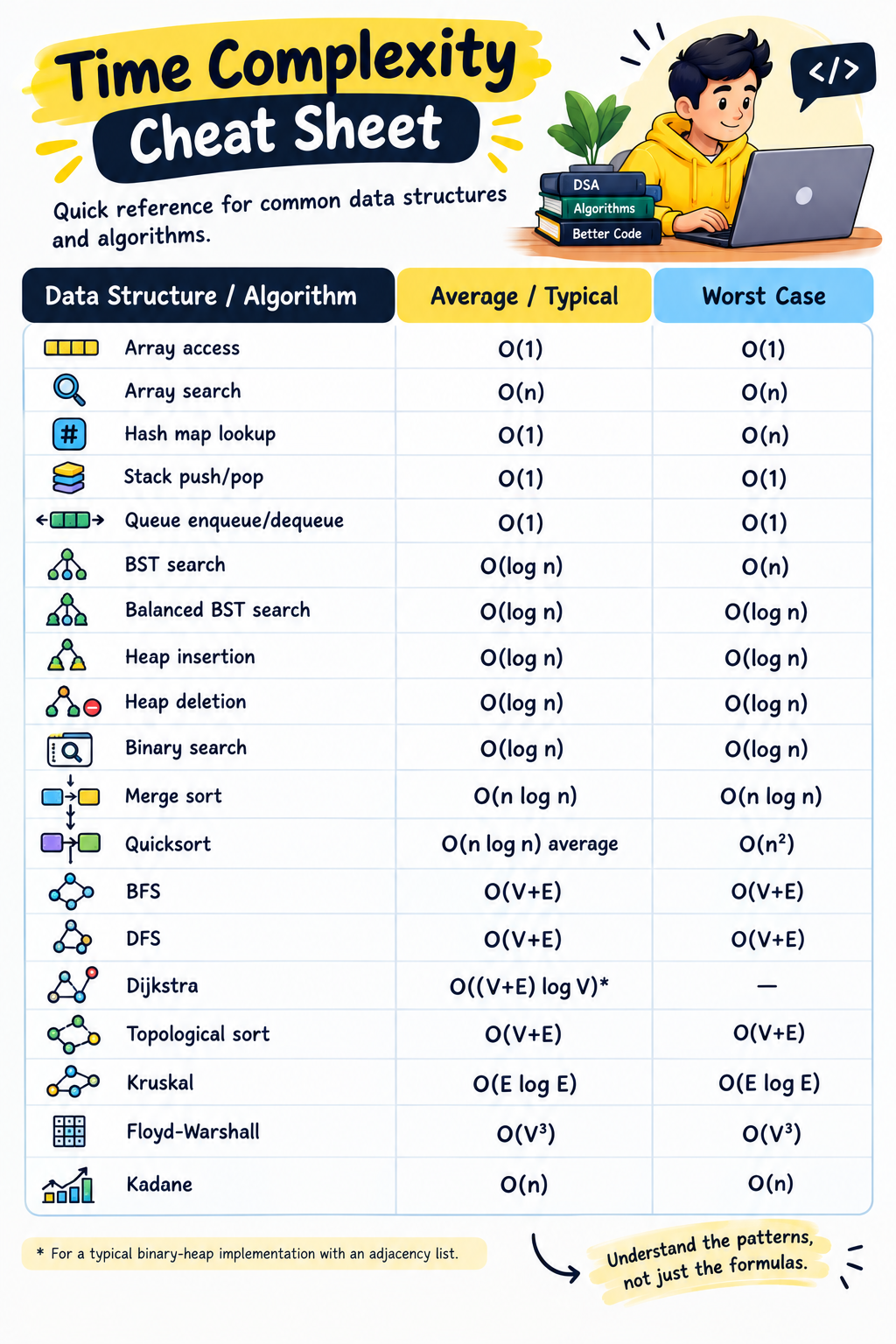
Most Important DSA Complexities to Remember

DSA Complexities

How Interviewers Usually Increase the Difficulty

A strong interviewer rarely stops after the first correct answer.

For example:

Interviewer: Find two numbers that add up to a target.

Candidate: I can use a hash map in O(n).

Interviewer: What is the space complexity?

Candidate: O(n).

Interviewer: What if the array is sorted?

Candidate: I can use two pointers and reduce extra space to O(1).

Interviewer: What if the array is too large to fit into memory?

Candidate: Then I would reconsider the storage/streaming model and possibly use external sorting or a streaming approach depending on the exact constraints.

This is the level of reasoning experienced candidates should practice.

Final Thoughts: Prepare DSA With the Right Approach

DSA interview preparation is not about remembering every solution. It is about understanding how to approach a problem, choose the right data structure, identify the right algorithm, and explain your solution clearly.

Start with the basics, practice common patterns, and gradually move toward advanced problems. For every question, try to understand why a particular approach works, what its time and space complexity is, and how it can be optimized.

If you are a student or beginner looking to build stronger programming and technical interview skills, Skill Hives can help you develop practical knowledge through structured IT training and hands-on learning.

Keep practicing, solve problems consistently, and focus on improving your problem-solving skills one question at a time. With the right preparation and regular practice, DSA can become much easier to handle in technical interviews.

Frequently Asked DSA Interview Questions

1. What DSA topics should a fresher prepare first?

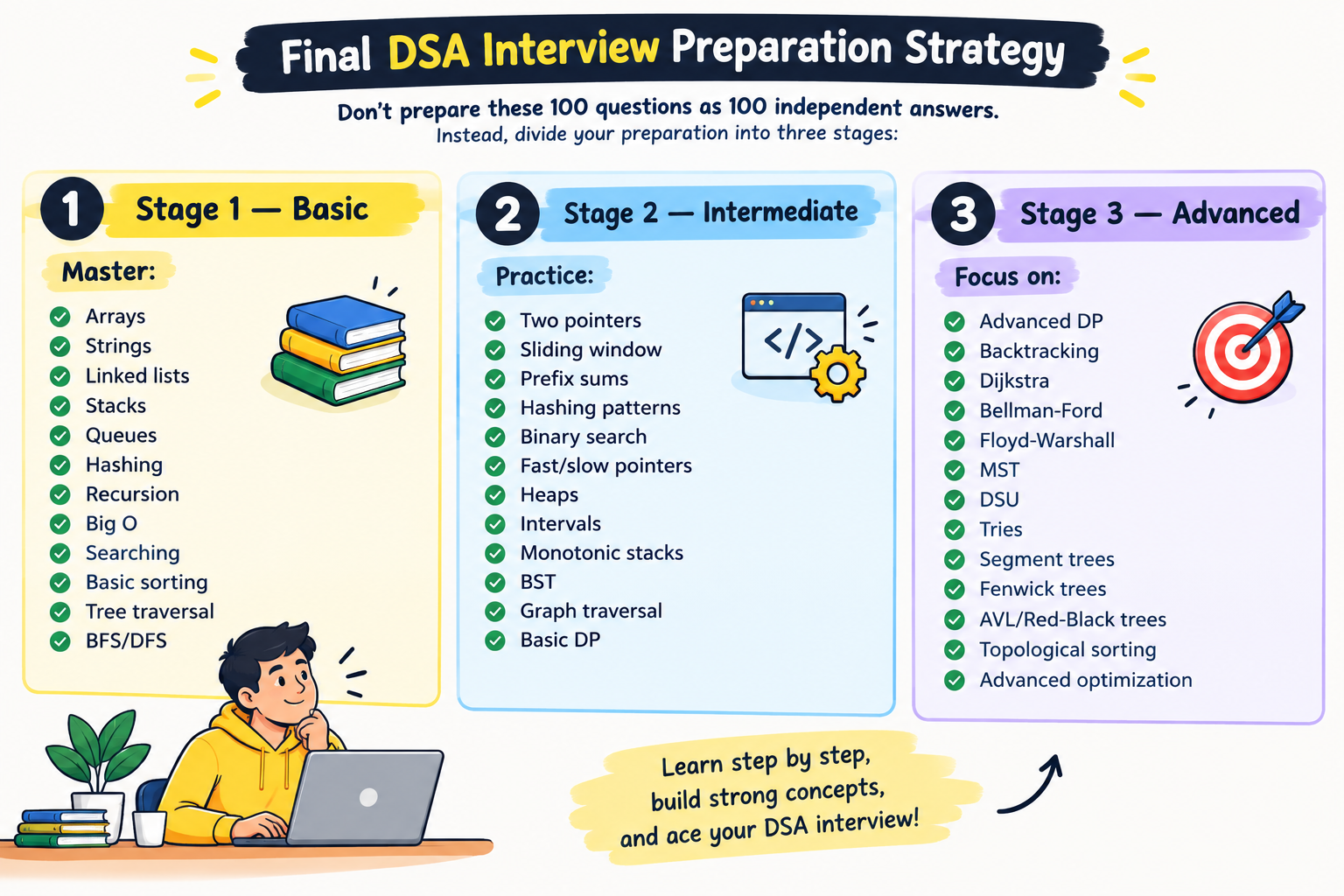
Start with arrays, strings, linked lists, stacks, queues, hashing, recursion, searching, sorting, trees, and basic graphs. Then move to patterns such as two pointers, sliding window, binary search, BFS, DFS, and basic dynamic programming.

2. Which DSA questions are most commonly asked?

Frequently recurring problems include Two Sum, reverse linked list, linked-list cycle detection, binary search, valid parentheses, tree traversal, BFS/DFS, merge intervals, maximum subarray, top-K problems, shortest path, and dynamic programming problems. Current 2026 question lists repeatedly feature these problem families.

3. Are DSA questions important for experienced developers?

Yes. Experienced candidates are often expected to go beyond definitions and demonstrate optimization, complexity analysis, trade-offs, advanced graph/tree algorithms, concurrency-aware data-structure choices, and scalable solutions.

4. Should I memorize DSA solutions?

No. Memorize patterns and principles, not complete solutions. You should be able to reconstruct the solution when constraints change.

5. How much DSA should I prepare for a technical interview?

A useful preparation target is to become comfortable with the major patterns and solve a representative set of easy, medium, and hard problems rather than trying to memorize hundreds of unrelated questions.

6. Which programming language is best for DSA interviews?

Python, Java, C++, and JavaScript can all work. The best language is generally the one in which you can write correct code quickly and explain the implementation clearly.

7. What should I say when I don’t know the optimal solution?

Explain the brute-force approach first, state its complexity, identify its bottleneck, and then reason toward an optimization. Interviewers often evaluate the problem-solving process, not just whether you immediately know the final algorithm.

8. Is Big O important in DSA interviews?

Yes. You should be able to explain both time and space complexity and justify why your chosen approach meets the input constraints.

9. What is more important: data structures or algorithms?

Neither can be considered in isolation. The right algorithm often depends on the data structure. For example, Dijkstra’s algorithm becomes much more efficient with an appropriate priority queue.

10. How should I explain a DSA solution in an interview?

Use this sequence:

Clarify → Brute Force → Identify Bottleneck → Optimize → Explain Data Structure → Write Code → Test Edge Cases → Give Complexity.

Final DSA Interview Preparation Strategy

Where to Get a UI UX Design Internship in Chandigarh & Mohali?

Students can get a UX design internship in Chandigarh and Mohali by building foundational UX and UI skills, creating 2–3 practical portfolio projects, learning tools such as Figma, applying to relevant internship programmes, and preparing for portfolio review and interview questions. A strong portfolio matters more than prior work experience for most entry-level UX internship roles.

What Students Want to Know Quick Answer
Who can apply? Students, graduates, beginners, and career switchers with relevant skills
Do I need experience? No, a strong beginner portfolio can help
What should I learn? UX research, wireframing, prototyping, UI design, and usability testing
Which tools should I know? Figma and other UX/UI design tools
What should my portfolio contain? 2–3 practical case studies showing your design process
Where can I apply? UX/UI agencies, software companies, startups, product companies, and training/internship programmes

Who Can Apply for a UX Design Internship in Chandigarh & Mohali?

A UX design internship is designed for people at the beginning of their design career, not for experienced professionals. If you are willing to learn, build projects, and engage seriously with the application process, you are a suitable candidate.

Students and graduates who commonly apply include:

  • Students pursuing design, computer science, IT, BCA, or related courses
  • Recent graduates looking for their first professional design experience
  • Beginners who are self-learning UX/UI design
  • Students building their first design portfolio
  • Career changers moving from another field who have relevant visual or analytical skills

Can You Get a UX Internship Without Experience?

Yes. Most UX internships, including ui ux internship and ux designer internship roles, explicitly target people without professional experience. Internships exist precisely to give people their first opportunity.

What matters more than prior work experience is your portfolio, your understanding of UX principles, and your ability to explain why you made the design decisions you did. A beginner who can walk an interviewer through a clear problem, a research process, and a considered solution is far more competitive than someone who submits a portfolio full of unconnected screenshots.

What Skills Do You Need for a UX Design Internship?

You do not need to master everything before applying. But you do need a working understanding of core UX and UI skills. Here is what most UX internship roles expect at the beginner level:

Skill What You Should Know
UX Research User interviews, surveys, and basic competitor research
Information Architecture Organising content, navigation, and user flows logically
Wireframing Creating basic page or app structures without visual design
Prototyping Building interactive flows that simulate real user interactions
Usability Testing Identifying design problems through structured user feedback
UI Design Layouts, typography, spacing, colour, and visual hierarchy
Design Systems Working with components, styles, and design consistency
Communication Explaining design decisions clearly to peers and stakeholders
Problem Solving Translating user problems into practical design solutions

Building these skills before applying makes the difference between a candidate who gets shortlisted and one who doesn’t. A ux internship application built on real skill development is always stronger than one based on theoretical knowledge alone.

Start Building Your UX/UI Skills Today

Learn the design tools and methods that internship-ready candidates actually use

WhatsApp Us

What Is the Difference Between UX, UI/UX and UI Design Internships?

Students searching for internship opportunities often find different titles and wonder what each actually involves. Here is a clear breakdown:

Internship Type Main Focus Typical Work
UX Design Internship User experience Research, user flows, wireframes, and usability testing
UI/UX Internship UX and interface design Research, wireframes, prototypes, and visual UI design
UI Design Internship Visual interface Layouts, typography, colour, and component design
UX Research Internship User research Interviews, surveys, usability testing, and research documentation
Product Design Internship End-to-end product experience Research, UX, UI, and product thinking

In practice, many roles, particularly at startups and small agencies, combine UX and UI responsibilities under a single ui ux designer internship or ui design internship title. Understanding the distinction helps you identify which role best matches your current strengths, and which skills to prioritise in your preparation.

What Does a UX Designer Intern Actually Do?

Knowing what an internship actually involves helps you prepare more specifically. A ux designer internship typically involves working alongside a design team on real or supervised design tasks.

Typical intern responsibilities include:

  • Understanding user requirements from briefs or research
  • Conducting basic UX research, surveys, competitor analysis, and user interviews
  • Creating user personas based on research findings
  • Mapping user journeys to identify pain points and opportunities
  • Building wireframes for app or web flows
  • Developing interactive prototypes using Figma or similar tools
  • Designing interface layouts for review by senior designers
  • Participating in usability testing sessions
  • Collecting and documenting user feedback
  • Iterating on designs based on feedback and testing results

Not every internship will cover all of these. Some will be more research-heavy. Others will focus primarily on visual design. Reading the internship description carefully tells you which direction a specific role leans.

What Is a UX Research Internship and What Does a UX Research Intern Do?

A ux research internship is a specific type of internship that focuses on the research and analysis side of UX rather than the design side. It is particularly suited to students who enjoy understanding people, patterns, and data.

What Does a User Experience Research Intern Do?

A user experience research intern typically works on:

  • Conducting user interviews with structured question sets
  • Designing and distributing user surveys
  • Performing competitor and comparative analysis
  • Running moderated and unmoderated usability tests
  • Documenting research findings in clear, accessible formats
  • Identifying user pain points and unmet needs
  • Translating research data into design recommendations for the broader team

A user experience research internship is not just about gathering data; it is about knowing what questions to ask, how to gather reliable answers, and how to present findings in a way that helps designers and product teams make better decisions. Students interested in a ux research internship should focus on building research planning, note-taking, and synthesis skills alongside their basic design knowledge.

What Projects Should You Complete Before Applying for a UX Internship?

Portfolio projects are your strongest asset as a beginner. You do not need dozens of projects; 2–3 well-explained case studies that show your thinking process are far more useful than a portfolio full of unfinished screens.

Project What It Demonstrates
Mobile App Redesign UX analysis, problem identification, and UI skills
Website Redesign Information architecture and visual design
E-commerce App User flows, product thinking, and checkout experience
UX Research Case Study Research planning, user interviews, and insight synthesis
Booking or Service App User journey mapping and interaction design
Dashboard Design Information hierarchy and data visualisation

For each project, document the full process: the problem you identified, the research you conducted, the decisions you made and why, your wireframes, your final design, and what you would improve. This process documentation is what distinguishes a professional case study from a screenshot gallery.

How to Build a UX Portfolio for an Internship?

Your portfolio should follow the actual design process, not just show the final outcome.

Problem → Research → User Insights → User Flow → Wireframes → Prototype → UI → Testing → Improvements

Each stage of the process tells the reviewer something about how you think. Skipping straight to the final screens tells them almost nothing useful.

What Should a Beginner UX Portfolio Include?

  • About section — who you are, what you are learning, and what type of work you are looking for
  • 2–3 case studies — each with a clear problem statement and documented process
  • Research section — user interviews, surveys, or competitor analysis, even at a beginner level
  • Wireframes — low-fidelity sketches or digital wireframes showing your structural thinking
  • Final designs — polished screens or prototype screens showing your UI skills
  • Prototype link — an interactive Figma prototype where possible
  • Design decisions — brief explanations of why you made key choices
  • Learnings — what you would do differently, which shows self-awareness
  • Contact information — how reviewers can reach you

Portfolio quality is one of the primary factors in internship for ui ux designer applications. A well-documented 2-project portfolio outperforms a poorly documented 8-project one almost every time.

Ready to Build Your UX Portfolio?

Get structured guidance on UX projects, Figma skills, and case study documentation

WhatsApp Us

Which Tools Should You Learn Before a UX Design Internship?

You do not need to learn every design tool before applying. Focus on the tools that appear most frequently in internship descriptions.

Tool Common Use
Figma UI design, wireframes, prototypes, and collaboration
FigJam Brainstorming, user flows, and collaborative workshops
Miro User journey mapping and research organisation
Adobe XD / Illustrator Interface design and visual assets
Usability Testing Tools Recording sessions, collecting feedback, and analysis

Figma is the most important tool to learn first. It is used across the vast majority of UX/UI roles in agencies, startups, and product companies. Once you are comfortable in Figma, other tools become easier to learn because the underlying logic is similar.

How to Find a UX Design Internship in Chandigarh & Mohali?

Finding the right internship requires a combination of search strategy, networking, and timing.

1. Company Career Pages

Look directly at the career or hiring pages of software companies, design agencies, startups, and product companies in Chandigarh, Mohali, and the wider tricity region. Many smaller companies post internship openings only on their own websites rather than on external platforms.

2. Internship Platforms

Use platforms like Internshala, LinkedIn, Naukri, and Indeed with targeted search terms:

  • UX Design Intern
  • UX Intern
  • UI/UX Intern
  • UI Designer Intern
  • UX Research Intern
  • Product Design Intern

Using specific search terms rather than broad ones filters out irrelevant results and increases the quality of what you find.

3. LinkedIn and Professional Networks

Set up a LinkedIn profile with your skills, portfolio link, and education clearly listed. Search for UX roles in Chandigarh and Mohali. Connect with designers, hiring managers, and agency recruiters in the region. Many internship opportunities are filled before they are advertised publicly; networking increases your access to these.

4. Training and Internship Programmes

For students who want structured preparation before applying independently, Skill Hives offers UX/UI training in Chandigarh and Mohali with a focus on portfolio development, practical projects, and internship readiness. This is particularly useful for students who are just starting out and want guidance alongside their learning rather than learning entirely on their own.

How to Apply for a UX Design Internship?

A step-by-step checklist for students preparing their application:

  • Step 1: Build your UX and UI fundamentals: research, wireframing, and basic visual design
  • Step 2: Learn Figma to a working level: wireframes, components, and interactive prototypes
  • Step 3: Complete 2–3 portfolio projects with full process documentation
  • Step 4: Create your portfolio either on a platform like Behance, Notion, or a personal website
  • Step 5: Prepare your resume, skills, tools, projects, and portfolio URL
  • Step 6: Search for relevant internship roles using the terms and platforms listed above
  • Step 7: Customise each application: connect your specific skills to what the role requires
  • Step 8: Prepare for the interview: practice explaining your projects and your design decisions
  • Step 9: Follow up professionally. A brief thank-you message after an interview is always appropriate

What Should You Put on Your Resume for a UX Internship?

Your resume for a UX internship should be simple, honest, and easy to scan.

Include:

  • UX/UI skills — research, wireframing, prototyping, usability testing, UI design
  • Tools — Figma, FigJam, Miro, Adobe tools
  • Academic projects — coursework with a design component
  • Personal projects — self-directed case studies from your portfolio
  • Certifications — any completed UX/UI or design courses
  • Portfolio URL — listed clearly at the top of the resume
  • Relevant coursework — design thinking, HCI, user research, or related modules
  • Research or design experience — even informal practice counts

Do not invent professional experience you do not have. Interviewers who work in UX can identify this immediately during a portfolio review. Personal and academic projects, presented honestly, demonstrate exactly the capability that an entry-level internship requires. Authenticity is more credible than exaggeration.

What Questions Are Asked in a UX Design Internship Interview?

Preparing for these questions before your interview significantly increases your confidence and performance.

Common questions include:

  • What is UX design and why does it matter?
  • What is the difference between UX and UI design?
  • How do you conduct user research?
  • What is a user persona and how do you create one?
  • What is a user journey map?
  • What is a wireframe, and when would you use one?
  • What is a prototype, and how is it different from a wireframe?
  • How do you test a design with real users?
  • Walk us through one of your portfolio projects from start to finish.
  • Why did you make a specific design decision in your work?

The most important of these is the last one. Being able to explain your thinking why you chose a layout, why you structured a user flow a certain way, and what you changed after testing demonstrates the kind of design reasoning that internship interviewers are actually looking for.

What Can You Learn During a UX Design Internship?

A well-structured ux internship takes you through the full design process in a professional environment. The typical progression looks like this:

UX Fundamentals → Research Methods → Information Architecture → Wireframing → Prototyping → UI Design → Usability Testing → Portfolio Case Study

Beyond technical skills, internships teach you how design teams work, how to give and receive feedback on design work, how to handle revision cycles professionally, and how to communicate your decisions to people who are not designers. These professional skills are just as important as the technical ones, and they cannot be learned from tutorials alone.

What Career Options Are Available After a UX Design Internship?

Completing a UX design internship or UX research internship opens doors to several career paths, depending on where your strengths and interests develop during the internship itself.

Career Role Main Focus
UX Designer Overall user experience — research, flows, wireframes, and testing
UI Designer Visual interface — layouts, typography, and component design
UI/UX Designer Combined UX and UI across the full design process
UX Researcher User research, testing, and insight generation
Product Designer End-to-end product experience from research to shipped design
Interaction Designer User interactions, micro-animations, and flow design

A product designer internship often leads directly to a product design role, one of the highest-value career paths in the design industry in 2026. Many UX interns who build strong portfolios during their internship move into full-time roles at the same company or use the experience to land their first junior position elsewhere.

Why Choose Skill Hives for UX/UI Internship Preparation in Chandigarh & Mohali?

Skill Hives is the training and internship division of Deftsoft, an active digital agency based in Mohali. UX/UI training at Skill Hives is practical and portfolio-focused, built for students who want to be internship-ready, not just course-certified.

What students get at Skill Hives:

  • Practical UX/UI learning covering research, wireframing, prototyping, and UI design
  • Portfolio-focused projects that produce real case studies you can show in applications
  • Industry-relevant tools training: Figma and supporting design tools
  • UX research exposure and methods practice
  • UI design practice on realistic briefs
  • Guidance from instructors who work in digital design
  • Preparation for portfolio reviews and internship interviews
  • Suitable for absolute beginners; no prior design experience required

Skill Hives is particularly well-suited to students who need structured guidance on building their portfolio, not just someone to point them towards tutorials online.

Prepare for Your UX Design Internship at Skill Hives

Practical training, real portfolio projects, and internship-ready skills in Chandigarh & Mohali

WhatsApp Us

UX Design Internship vs UI/UX Internship vs UX Research Internship

Role / Internship Best For Key Skills
UX Design Internship User experience Research, wireframes, user flows, usability testing
UI/UX Internship UX + interface design Research, UX, visual UI, prototyping
UI Design Internship Interface design Visual design, typography, colour, and components
UX Research Internship User research Interviews, surveys, testing, and research synthesis
Product Design Internship Full product development UX, UI, research, and product thinking

If you are unsure which type to pursue, start with a UI/UX internship. It gives you exposure to both research and design, which helps you discover which direction interests you more before specialising.

Frequently Asked Questions About UX Design Internships

How can I get a UX design internship in Chandigarh and Mohali?

Build basic UX and UI skills, learn Figma, complete 2–3 portfolio projects with full process documentation, create a portfolio, prepare your resume with your portfolio URL, and search for internship roles on LinkedIn, Internshala, and company career pages. Structured training programmes like Skill Hives can help students prepare more efficiently.

Can I get a UX internship without experience?

Yes. Most UX internships are specifically designed for beginners without professional experience. A practical portfolio that shows your design process, problem, research, wireframes, and final design is more useful than prior work experience for an entry-level ux internship application.

What skills are required for a UX design internship?

UX research, wireframing, prototyping, basic UI design, and the ability to explain design decisions. Familiarity with Figma is expected in most roles. Strong observation skills, curiosity about user behaviour, and clear communication are also valued.

What does a UX designer intern do?

A ux designer internship typically involves user research, creating personas and user journeys, building wireframes and prototypes, assisting with interface design, participating in usability testing, and iterating on designs based on feedback. Exact responsibilities vary by company and team.

What is the difference between a UX and UI/UX internship?

A UX design internship focuses on the user experience side: research, flows, and problem-solving. A ui ux internship covers both UX and visual interface design. A UI/UX role is broader and requires competence in both research-led design and visual execution.

What does a UX research intern do?

A user experience research intern conducts user interviews, designs surveys, runs usability tests, documents research findings, identifies user pain points, and translates insights into design recommendations. The role focuses on understanding users rather than creating visual designs.

Do I need a UX portfolio for an internship?

Yes. A portfolio is expected for almost every UX design internship application. 2–3 well-documented case studies showing your problem-solving process are more effective than a large portfolio of unconnected final screens.

Which tools should I learn for a UX internship?

Start with Figma it is used in the vast majority of UX/UI roles. Once you are comfortable in Figma, add FigJam for collaborative flows, Miro for research mapping, and basic knowledge of usability testing tools. Depth in Figma is more valuable than surface-level familiarity with many tools.

What is the difference between a UX research internship and a UX design internship?

A ux research internship focuses on understanding users through interviews, surveys, and testing, with outputs like research reports and design recommendations. A UX design internship uses that research to create wireframes, prototypes, and interface designs. Research interns work more with data; design interns work more with Figma.

Can a UX internship lead to a product design career?

Yes. A product designer internship or UX design internship is a common entry point into a product design career. Interns who build strong portfolios during their internship often move into junior UX, UI/UX, or product design roles at the same company or elsewhere. Product design is one of the strongest career paths emerging from the UX internship pathway in 2026.

Data Science Course in Chandigarh: Fees, Duration, Eligibility & Career Scope

Data is everywhere in the apps we use, the ads we see, the products companies build, and the decisions businesses make every single day. Data science is the skill that turns all that raw data into something useful: predictions, patterns, and real business insights. As AI, machine learning, and analytics become part of nearly every industry, data science has quietly become one of the most valuable career skills a student or professional can learn.

If you’re exploring a data science course in Chandigarh, you probably have a few questions on your mind:

  • What exactly is a data science course?
  • Who can join it?
  • What is the eligibility?
  • How long does it take?
  • What are the fees?
  • What career opportunities does it actually open up?

This guide walks through all of it in detail. And if you’re looking for a training option that focuses on practical, hands-on data education in Chandigarh, Skill Hives is worth exploring as you read through the sections below.

Not sure where to start with data science?

Talk to a Skill Hives mentor and get a personalised learning path based on your background and goals.

WhatsApp Us

What Is Data Science?

Data science is the field that combines programming, statistics, and business understanding to extract meaningful insights from data. It’s not just about numbers it’s about using those numbers to answer real questions: Which customers are likely to leave? Which product will sell best next month? Where is fraud most likely to occur?

How Does Data Science Work?

At a basic level, data science follows a simple, repeatable process:

Data Collection → Data Cleaning → Data Analysis → Data Visualization → Machine Learning → Business Insights

Every data science project, whether it’s for a bank, an e-commerce company, or a hospital, moves through some version of this pipeline. Raw data rarely arrives clean or ready to use, so a large part of the job involves preparing it before any real analysis or modelling begins.

Why Is Data Science Important for Businesses?

Businesses today rely on data science for far more than reporting numbers. It plays a role in:

  • Better, faster decision-making
  • Understanding customer behaviour and preferences
  • Automating repetitive processes
  • Predictive analysis for sales, demand, and risk
  • Fraud detection in banking and finance
  • Business forecasting and planning
  • Building AI-powered products and solutions

You don’t need a technical background to understand why this matters companies that use data well tend to make fewer costly mistakes and spot opportunities faster than those that don’t.

Why Choose a Data Science Course in Chandigarh?

Chandigarh has grown into one of North India’s strongest IT and education hubs, with a steady mix of IT companies, startups, and analytics-driven businesses setting up here. That means local demand for data professionals is real, not theoretical. Choosing a data science course in Chandigarh puts you closer to internship opportunities, industry mentors, and a peaceful academic environment that’s more affordable than studying in a metro city while still giving you access to the same modern curriculum, tools, and technologies used everywhere else.

Who Should Join a Data Science Course?

Data science isn’t reserved for one type of learner. Here’s how it fits different stages of life and career.

Students After 12th

If you’ve just finished school, a data science course helps you build foundational skills in programming, logic, and statistics early, giving you a strong head start before or alongside a formal degree.

College Students

Whether you’re pursuing BCA, BSc, BTech, BCom, or BA, data science skills complement almost any degree. Commerce and arts students, in particular, can use data skills to stand out in a market full of generic degree-holders.

Graduates and Freshers

For graduates and freshers, the goal is usually building a strong portfolio. A structured course with real projects helps you become genuinely job-ready instead of just degree-ready.

Working Professionals

Data science can support career growth for professionals already working in IT, finance, marketing, or operations. It’s also a common path for specialisation moving from a generalist role into analytics, ML, or AI-focused positions.

Career Switchers

You don’t need a technical background to switch into data science. Most learners start with programming and statistics fundamentals before gradually moving into machine learning and advanced concepts; it’s a progression, not a leap.

Freelancers and Entrepreneurs

If you run a business or work independently, data analysis skills help with business reporting, understanding your customers, and making informed decisions without depending on someone else to interpret your numbers for you.

Whichever stage you’re at, there’s a starting point for you

Skill Hives designs its data-focused training around real skill levels from complete beginners to working professionals switching careers.

Chat with us on WhatsApp

Data Science Course Eligibility

Quick answer: Most data science courses, especially foundation and professional-level programs, don’t require a technical degree. What matters more is your willingness to learn programming, statistics, and logical thinking. Eligibility does vary depending on the level and type of course you choose.

Basic Educational Qualification

Generally, completing 12th grade is enough to start a foundation-level data science course. Degree holders from any stream commerce, arts, science, or engineering can join intermediate or advanced programs.

Is Mathematics Required for Data Science?

You don’t need to be a math genius, but a working understanding of the following helps a lot:

  • Basic mathematics
  • Statistics (mean, probability, distributions)
  • Logical reasoning

Courses are usually structured to build these concepts from the ground up, so students with weaker math backgrounds can still catch up with consistent practice.

Can Non-Technical Students Learn Data Science?

Yes. Non-technical students typically begin with programming basics (usually Python) and statistics fundamentals, then progressively move into data analysis, visualization, and machine learning. It’s a gradual learning curve, not something you’re expected to know on day one.

Can I Join a Data Science Course After 12th?

Yes, a data science course after 12th is one of the most common entry points for students who want an early head start before or during their undergraduate studies. Foundation-level courses are specifically designed for this age group, focusing on building programming and analytical thinking from scratch.

Data Science Course Duration in Chandigarh

Course duration depends heavily on depth and level. Here’s a general breakdown:

Course Level Typical Duration Suitable For
Foundation 3–4 Months Beginners
Professional 6 Months Students & Career Switchers
Advanced 6–12 Months Graduates & Professionals
Degree Program 2–4 Years Students seeking formal qualifications

Actual duration within these ranges depends on several factors:

  • Curriculum depth
  • How much programming is covered
  • Whether machine learning is included
  • Number and complexity of projects
  • Whether an internship is part of the program
  • Certification requirements
  • Learning format (weekday, weekend, or online)

Data Science Course Fees in Chandigarh

Fees for a data science course can vary considerably depending on the institute, course duration, delivery mode, and what’s actually included in the program.

Factors That Affect Data Science Course Fees

  • Course duration
  • Faculty and mentorship quality
  • Live project inclusion
  • Internship opportunities
  • Certification
  • Placement assistance
  • Classroom vs online training
  • Advanced AI/ML modules

What Should You Check Before Paying the Course Fee?

Before paying for any course, run through this checklist:

  • ☑ Complete syllabus
  • ☑ Project work included
  • ☑ Trainer experience
  • ☑ Class size
  • ☑ Internship opportunities
  • ☑ Certification
  • ☑ Placement assistance
  • ☑ Refund and payment terms

It’s worth being cautious of institutes that quote unusually low fees without explaining what’s actually included; a lower price often means fewer projects, less mentorship, or no placement support.

Data Science Course Syllabus

This is where most of the real learning happens, so it’s worth understanding what a well-rounded syllabus should actually cover.

Python for Data Science

  • Python fundamentals
  • NumPy
  • Pandas
  • Data manipulation

A strong Python training foundation is non-negotiable in data science nearly every other module, from data cleaning to machine learning, builds directly on Python skills.

Statistics for Data Science

  • Mean, median, and mode
  • Probability
  • Distributions
  • Correlation
  • Regression basics

SQL and Database Management

  • SQL fundamentals
  • Writing queries
  • Joins
  • Filtering
  • Aggregation

Data Visualization

  • Charts and graphs
  • Dashboards
  • Data storytelling
  • Visualization tools

Machine Learning

  • Supervised learning
  • Unsupervised learning
  • Classification
  • Regression
  • Clustering
  • Model evaluation

Artificial Intelligence and Generative AI

Understanding how these fields connect helps put the bigger picture together:

Data Science → Machine Learning → AI → Generative AI

Each layer builds on the one before it data science lays the foundation, machine learning automates pattern recognition, AI applies that at scale, and generative AI creates entirely new content from what it has learned.

Real-World Data Science Projects

A good course should include practical projects such as:

  • Sales prediction
  • Customer segmentation
  • Fraud detection
  • Customer churn prediction
  • Recommendation systems
  • Business dashboards

Projects like these are what actually make your resume stand out they prove you can apply concepts, not just recite them.

Skills You Can Learn in a Data Science Course

  • Python programming
  • SQL
  • Statistics
  • Data cleaning
  • Data analysis
  • Data visualization
  • Machine learning
  • Problem-solving
  • Business intelligence
  • AI-assisted analytics
  • Communication and data storytelling
  • Project management

Career Opportunities After a Data Science Course

Completing a data science course opens doors to several roles, not just one fixed job title.

Data Scientist

Data Analyst

Machine Learning Engineer

Business Intelligence Analyst

Data Engineer

Machine Learning Analyst

AI/ML Specialist

Business Analyst

The exact role you land depends on your education, technical skills, project experience, and how far you’ve progressed through the syllabus someone strong in visualization and reporting may lean toward BI Analyst roles, while someone strong in ML modelling may move toward ML Engineer positions.

Data Science Salary in India

Rather than promising a specific number, it’s more honest to look at salary progression by experience level:

Experience Level Potential Career Stage
Fresher Entry-level roles
1–3 Years Junior/Mid-level roles
3–5 Years Experienced specialist roles
5+ Years Senior/Lead/Managerial roles

Actual salaries vary significantly based on your skills, location, company size, education, specific role, and years of experience so treat this as a general trajectory rather than a guarantee.

Data Science vs Data Analytics vs Machine Learning

If you’re still unsure which path fits you, this comparison should help:

Feature Data Science Data Analytics Machine Learning
Main Focus Data + prediction Insights & reporting Predictive models
Programming High Moderate High
Statistics High Moderate High
AI/ML Strong Optional/Moderate Core
Suitable For Advanced data careers Beginners & analysts Technical specialists

If you’re just starting out and want a beginner-friendly path into the data world, a data analytics training program is often the more approachable first step before moving into full data science or machine learning.

How to Choose the Best Data Science Course in Chandigarh

Check the Course Syllabus

Make sure it covers Python, statistics, SQL, visualization, and machine learning not just one or two of these.

Look for Hands-On Projects

Theory alone won’t get you hired. Projects prove you can apply what you’ve learned.

Check Trainer Experience

Look for mentors who’ve actually worked in data roles, not just taught from a textbook.

Look for Internship Opportunities

Internships bridge the gap between classroom learning and real workplace experience.

Check Certification

A recognised certificate adds credibility to your resume.

Evaluate Placement Assistance

Resume support, interview prep, and job referrals matter more than most students realise going in.

Compare Course Duration and Fees

Match the duration and cost against what’s actually included in the curriculum.

Check Student Reviews and Outcomes

Past student experiences are often the most honest indicator of course quality.

Why Choose Skill Hives for Data Science Training in Chandigarh?

Skill Hives approaches data-focused education with a strong emphasis on practical, structured learning rather than theory-heavy lectures. Here’s what makes it a solid option for BCom, BCA, BSc, BTech graduates, and working professionals alike:

  • Practical and structured learning path
  • Beginner-friendly approach for non-technical students
  • Industry-relevant curriculum built around current tools
  • Hands-on projects throughout the program
  • Experienced mentors guiding students one-on-one
  • Career-oriented training focused on job readiness
  • Support tailored for both students and working professionals
  • Strong focus on current technologies including Python, analytics, ML, and AI
  • Internship and project exposure as part of the broader IT training program

As one of the established IT training program providers in the Mohali–Chandigarh region, Skill Hives blends its Python training, data analytics training, and AI/ML modules into a single, practical learning ecosystem rather than teaching each skill in isolation.

Data Science Course Learning Roadmap for Beginners

If you’re starting from zero, here’s a realistic step-by-step roadmap:

Step 1: Learn Python Basics ↓

Step 2: Learn Statistics ↓

Step 3: Learn SQL ↓

Step 4: Learn Data Analysis ↓

Step 5: Learn Data Visualization ↓

Step 6: Learn Machine Learning ↓

Step 7: Build Projects ↓

Step 8: Create a Portfolio ↓

Step 9: Apply for Jobs/Internships

Following this order matters, jumping straight into machine learning without solid Python and statistics foundations usually leads to confusion and half-understood concepts.

Ready to follow this roadmap with expert guidance?

Skill Hives’ data analytics training and Python training modules are structured around exactly this progression from fundamentals to job-ready projects.

Ask Us on WhatsApp

Is Data Science a Good Career in 2026?

Yes, data science remains a genuinely strong career choice heading into 2026 though it’s worth understanding why, rather than taking that on faith.

The reasons are fairly consistent across industries: AI adoption is accelerating, businesses are generating more data than ever, and demand for people who can turn that data into decisions keeps growing. Automation and machine learning are handling more routine analysis, which means the value shifts toward people who understand both the technical and business sides of data. Data-driven decision-making has become standard practice, not a competitive edge which means opportunities exist across almost every industry, not just IT.

That said, it’s worth being realistic: no course can promise a guaranteed job or a guaranteed salary. What a good course can do is prepare you with the right skills, projects, and portfolio to compete for these opportunities.

Industries That Hire Data Science Professionals

Data science roles aren’t limited to IT companies. Industries actively hiring data professionals include:

  • IT
  • Banking & Finance
  • Healthcare
  • E-commerce
  • Retail
  • Manufacturing
  • Telecommunications
  • Education
  • Marketing
  • Logistics
  • Insurance
  • Travel & Hospitality

This breadth is part of what makes data science such a flexible skill. The same core training can lead to very different career paths depending on which industry interests you.

Data Science Course in Chandigarh for Working Professionals

If you’re already employed, fitting in a new course might feel difficult but most modern programs are built with this exact concern in mind.

  • Flexible learning options for working schedules
  • Weekend and evening class formats
  • Online learning for remote flexibility
  • Focused skill upgrades rather than starting from scratch
  • Support for full career transitions into data roles
  • Learning at your own pace alongside a full-time job
  • Building real projects while still employed, so you’re job-ready before you make the switch

This flexibility is often what separates professionals who successfully pivot into data careers from those who keep postponing it.

Data Science Course After 12th vs After Graduation

Factor After 12th After Graduation
Starting Point Beginner Beginner/Intermediate
Focus Fundamentals Advanced concepts
Career Goal Build skills Career specialization
Mathematics Basic to intermediate Intermediate/advanced
Projects Beginner projects Advanced projects

Neither path is objectively better. Starting after 12th gives you more time to build depth gradually, while starting after graduation lets you move faster into specialised, career-focused learning.

Frequently Asked Questions About Data Science Course in Chandigarh

1. What is the eligibility for a data science course in Chandigarh?

Most foundation and professional-level courses only require completion of 12th grade or a graduate degree in any stream. Technical background isn’t a mandatory willingness to learn programming and statistics matters more.

2. Can I do a data science course after 12th?

Yes, foundation-level data science courses are specifically designed for students after 12th, focusing on building programming and analytical fundamentals from scratch.

3. What is the duration of a data science course?

Duration ranges from 3–4 months for foundation courses to 6–12 months for advanced programs, and 2–4 years for formal degree programs, depending on depth and format.

4. What is the average data science course fee in Chandigarh?

Fees vary based on the institute, duration, delivery mode, and inclusions like projects, internships, and placement support. It’s best to compare what’s included rather than fees alone before deciding.

5. Can a non-IT student learn data science?

Yes. Non-technical students typically start with Python training and statistics fundamentals before progressing into analysis, visualization, and machine learning; no prior IT background is required.

6. Is mathematics necessary for data science?

A basic to intermediate understanding of statistics and logical reasoning is helpful, but you don’t need advanced mathematics to begin. Most courses build these concepts progressively.

7. What will I learn in a data science course?

A well-rounded course typically covers Python, SQL, statistics, data visualization, machine learning, and hands-on projects such as sales prediction, customer segmentation, and recommendation systems.

8. What jobs can I get after a data science course?

Common roles include Data Scientist, Data Analyst, Machine Learning Engineer, Business Intelligence Analyst, Data Engineer, and AI/ML Specialist, depending on your skill depth and project experience.

Final Thoughts

Data science isn’t a passing trend, it’s steadily becoming a core skill across almost every industry, from banking to healthcare to e-commerce. Whether you’re a student straight out of 12th, a graduate building your first portfolio, or a working professional planning a career switch, there’s a realistic entry point for you.

What matters most is choosing training that goes beyond theoretical practical Python training, real data analytics training, hands-on projects, and mentors who’ve actually worked in the field. Skill Hives brings all of this together as part of its broader IT training program in Chandigarh, built around live projects, one-on-one mentorship, and current tools rather than outdated classroom teaching.

Ready to build a career in data science?

Join Skill Hives in Chandigarh for practical Python training, data analytics training, and hands-on projects that prepare you for real data science roles.

What Is the Best Course After BCom? Top Career Options in 2027

What Should You Do After BCom?

“You have completed BCom. What should you do next?”

It’s the question every commerce graduate eventually asks themselves, and honestly, there isn’t one single right answer. BCom opens up several career paths, but the course you choose next really depends on a handful of personal factors:

  • Your career goal
  • Your interest
  • Your existing skills
  • Your expected salary
  • The time you have available for learning
  • Whether you want a job, a business of your own, or higher education

Here’s something worth remembering: students don’t always need to limit themselves to the traditional options like M.Com or MBA. Practical options like a 6 month industrial training or skill-based courses can prepare graduates just as effectively, and often faster, for the job requirements that are actually changing around them right now.

Quick Answer: The best course after BCom depends on your career goal. Popular options include MBA, CA, CMA, ACCA, Financial Analytics, Digital Marketing, Data Analytics, and other job-oriented skill courses.

Ready to figure out where you fit?

and talk to a mentor before you commit to any course.

WhatsApp Us

Table of Content

1. What Should You Do After BCom?

2. Career Options After BCom: The Big Picture

3. How to Choose the Best Course After BCom?

4. 10 Best Courses After BCom in 2027

1. MBA

2. Chartered Accountancy (CA)

3. CMA

4. ACCA

5. CFA

6. Data Analytics

7. Digital Marketing

8. Web Development

9. UI/UX Design

10. AI & Machine Learning

5. Quick Comparison: Which Course Is Best After BCom?

6. Which Course After BCom Is Best for You?

7. Why Skill-Based Courses Can Be Useful After BCom

8. Why Choose Skill Hives for Career-Focused Training?

9. How to Choose the Right Training Institute After BCom?

10. Skill Hives Course Selection Guide for BCom Students

11. Common Mistakes BCom Graduates Make While Choosing a Course

FAQs: Best Course After BCom

Final Thoughts

2. Career Options After BCom: The Big Picture

Think of your options as branching into three broad directions:

  • Higher Studies — MBA, M.Com, Finance specialisations
  • Professional Courses — CA, CMA, ACCA, CFA
  • Skill-Based Courses — Digital Marketing, Data Analytics, AI/ML, Web Development, UI/UX Design

All three paths eventually lead toward the same destination: careers in banking & finance, accounting, marketing, business, and analytics. The difference is in how fast you get there, how much you invest, and how hands-on the learning is along the way.

3. How to Choose the Best Course After BCom?

There is no single best course for every BCom graduate. What works for your classmate might be completely wrong for you. Before you decide, sit with these five questions:

Factor Ask Yourself
Interest What type of work do I enjoy?
Career Goal Which job role do I actually want?
Time How quickly do I want to start working?
Budget How much can I realistically invest in learning?
Skills What skills are employers actually asking for right now?

A simple tip that saves a lot of confusion: choose the career first, then choose the course. Too many students do it backwards; they pick a popular course and then try to force-fit a career around it.

4. 10 Best Courses After BCom in 2027

Here’s a mix of traditional professional qualifications and modern, job-oriented skill courses that BCom graduates are actively choosing right now.

1. MBA

Best for: Students interested in management, business, marketing, HR, finance, or entrepreneurship.

Career options: Marketing Manager, Business Analyst, HR Manager, Finance Manager, Business Development Executive

Why choose it? An MBA helps build management and business decision-making skills, which is useful if you’re aiming for leadership-oriented roles down the line.

2. Chartered Accountancy (CA)

Best for: Students who enjoy accounting, taxation, auditing, and finance.

Career options: Chartered Accountant, Auditor, Tax Consultant, Financial Advisor

Why choose it? CA remains one of the strongest options for anyone who wants a long-term, high-respect career in accounting and finance.

3. CMA

Best for: Students interested in cost management, accounting, financial planning, and business decisions.

Career options: Cost Accountant, Financial Analyst, Management Accountant, Finance Executive

4. ACCA

Best for: Students interested in accounting and international finance.

Career options: Financial Accountant, Audit Associate, Finance Manager, Management Accountant

5. CFA

Best for: Students interested in investment, financial markets, and investment analysis.

Career options: Investment Analyst, Equity Research Analyst, Portfolio Analyst, Financial Analyst

6. Data Analytics

Best for: BCom students who enjoy working with numbers, business insights, and technology.

Your commerce background actually gives you a head start here. Combining that foundation with data skills prepares you for roles that revolve around business reporting, data interpretation, and decision-making skills every company needs but very few graduates actually have.

Career options: Data Analyst, Business Analyst, Reporting Analyst, Business Intelligence Executive

How Skill Hives helps: Data Analytics Course by Skill Hives focuses on practical, industry-oriented learning and includes data-focused and technology training within its broader curriculum. The emphasis throughout is on hands-on projects and expert guidance rather than theory alone, exactly what you need if you’re transitioning from a commerce degree into an analytics role.

7. Digital Marketing

Best for: Students interested in marketing, social media, SEO, advertising, content, and online business.

What you’ll learn: SEO, Social Media Marketing, Google Analytics, Paid Advertising, Content Marketing, Digital Strategy

Career options: Digital Marketing Executive, SEO Executive, Social Media Executive, Performance Marketing Executive, Content Executive

How Skill Hives helps: Skill Hives offers Digital Marketing Training with real, hands-on exposure to the tools and platforms companies actually use. Its training approach is built around industry-focused, practical learning, a solid fit for BCom graduates who want to pair their business knowledge with in-demand digital skills.

See yourself in a marketing role?

Learn SEO, Google Ads, and analytics with live projects.

WhatsApp Us

8. Web Development

Best for: Students who want to move from commerce into technology.

You don’t need an engineering degree to build a career in tech. BCom graduates can enter technology-related roles by learning practical development skills that employers actively hire for.

Career options: Web Developer, Full-Stack Developer, Front-End Developer, WordPress Developer

How Skill Hives helps: Skill Hives provides Web Development Training covering full-stack development and multiple technology stacks, with a strong emphasis on live projects and hands-on practice rather than passive lectures.

9. UI/UX Design

Best for: Creative students interested in websites, mobile apps, design, and user experience.

Skills to learn: UI Design, UX Research, Wireframing, Prototyping, Figma, User Experience Design

Career options: UI Designer, UX Designer, Product Designer, UI/UX Intern

Skill Hives includes UI/UX training focused on creating user-friendly digital products, with tools such as Figma built into the training ecosystem.

10. AI & Machine Learning

Best for: Students interested in emerging technology and data-driven careers.

AI is increasingly being used across business, marketing, finance, and customer service which means BCom graduates who understand both business context and AI tools have a genuine edge.

Possible career directions: AI-related roles, data-focused roles, machine learning roles, AI-assisted business applications

How Skill Hives helps: Skill Hives offers AI and Machine Learning training designed for freshers and intermediate learners, with an emphasis on practical technology skills over theory-heavy coursework.

5. Quick Comparison: Which Course Is Best After BCom?

Course Best For Career Direction Learning Type
MBA Business & Management Management Higher Education
CA Accounting & Tax Finance Professional Qualification
CMA Cost & Finance Corporate Finance Professional Qualification
ACCA International Accounting Finance Professional Qualification
CFA Investment Financial Markets Professional Qualification
Data Analytics Numbers & Data Analytics Skill-Based
Digital Marketing Marketing Digital Careers Skill-Based
Web Development Technology IT Skill-Based
UI/UX Creative Students Design & Product Skill-Based
AI & ML Technology AI/Data Skill-Based

6. Which Course After BCom Is Best for You?

A quick decision guide based on what genuinely interests you:

  • Finance & Accounting → CA / CMA / ACCA / CFA
  • Business & Management → MBA
  • Marketing & Social Media → Digital Marketing
  • Numbers + Technology → Data Analytics
  • Coding & Technology → Web Development
  • Creativity & Design → UI/UX
  • Emerging Technology → AI & Machine Learning

7. Why Skill-Based Courses Can Be Useful After BCom

A BCom degree gives you a solid foundation in commerce and business concepts. What it often doesn’t give you is the practical, tool-based experience employers now expect on day one. That’s the gap skill-based learning fills.

Benefits of skill-based learning:

  • Practical, job-relevant knowledge
  • Exposure to industry-standard tools
  • Real project experience for your portfolio
  • A clearer understanding of actual workplace requirements
  • Portfolio development you can show in interviews
  • Exposure to current, in-demand technologies

Skill Hives specifically highlights live projects, practical sessions, expert mentorship, one-to-one guidance, and industry-oriented learning as the core parts of its training approach rather than relying on classroom theory alone.

8. Why Choose Skill Hives for Career-Focused Training?

Since this is a question a lot of BCom graduates end up asking, it’s worth answering directly and honestly.

What sets Skill Hives apart:

  • Industry-focused training
  • Practical, hands-on learning
  • Live project experience with real clients
  • Expert mentorship from industry veterans
  • One-to-one guidance instead of generic batch teaching
  • Personality development and communication training
  • Exposure to industry-standard tools
  • Career-oriented training built around actual job requirements

Skill Hives designs its programs to bridge the gap between theory and practical work. Its training includes live projects, experienced instructors, structured practical sessions, ongoing mentorship, and direct exposure to the tools companies use every day. The training areas span Digital Marketing, Web Development, AI & Machine Learning, UI/UX, and Mobile App Development giving BCom graduates several credible technology-focused directions to explore, not just one.

Not sure which track fits you best?

Get guidance tailored to your BCom background before you enroll in anything.

WhatsApp Us

9. How to Choose the Right Training Institute After BCom?

Before you commit your time and money to any institute, run through this checklist:

  • ☑ Course syllabus
  • ☑ Trainer experience
  • ☑ Practical projects
  • ☑ Course duration
  • ☑ Tools covered
  • ☑ Internship opportunities
  • ☑ Career support
  • ☑ Student reviews
  • ☑ Certification
  • ☑ Demo class

Skill Hives itself recommends this exact approach comparing curriculum, trainers, practical projects, duration, fees, student feedback, career support, and trainer interaction before you enroll anywhere. It’s good advice regardless of which institute you eventually choose.

10. Skill Hives Course Selection Guide for BCom Students

If You Like… Consider
Marketing & social media Digital Marketing
SEO & online growth SEO / Digital Marketing
Numbers & business data Data Analytics
Coding Web Development
Design & creativity UI/UX
AI & emerging technology AI & ML
Business management MBA
Accounting CA / CMA / ACCA

11. Common Mistakes BCom Graduates Make While Choosing a Course

Before you lock in a decision, it helps to know where most students go wrong:

  • Following the crowd: Choosing MBA or CA simply because friends or seniors did it, without checking if it actually matches personal interest.
  • Ignoring timelines: Professional courses like CA or CFA can take several years to complete. If you want to start earning sooner, a skill-based course may fit better.
  • Skipping the practical check: Enrolling in a course without confirming whether it includes live projects, tools, and mentorship theory alone rarely gets you hired in 2027.
  • Not researching the institute: Picking based on advertisements alone instead of checking trainer experience, syllabus depth, and placement support.
  • Underestimating skill-based careers: Assuming that only traditional degrees lead to “real” jobs, while ignoring how fast Digital Marketing, Data Analytics, and AI-related roles are growing across Mohali, Chandigarh, and the rest of India.

Avoiding these mistakes alone can save you months, sometimes years, of misdirected effort.

FAQs: Best Course After BCom

1. What is the best course after BCom?

There’s no single “best” course; it depends on your interest and career goal. MBA, CA, and CFA suit students who want a traditional finance or management path, while Digital Marketing, Data Analytics, and AI & ML suit students who want faster, skill-based entry into the job market.

2. Which course after BCom is best for a high salary?

CA, CFA, and MBA can lead to high-paying roles over time, but they typically require years of study. Skill-based courses like Digital Marketing, Data Analytics, and AI & ML can get you into paying, in-demand roles much faster, with salary growth tied directly to your practical skills and project experience.

3. Can I do a technology course after BCom?

Yes. BCom graduates regularly move into technology roles through courses like Web Development, UI/UX Design, Data Analytics, and AI & Machine Learning. You don’t need a technical degree to start, you need practical, project-based training.

4. Is digital marketing a good course after BCom?

Yes. Digital Marketing is one of the most popular skill-based options for commerce graduates because it combines business understanding with in-demand digital skills like SEO, social media marketing, and Google Ads.

5. Can I learn digital marketing after BCom?

Absolutely. In fact, a commerce background often helps, since you already understand business fundamentals like target audiences, ROI, and market strategy. Digital Marketing training simply adds the practical tools and platforms on top of that.

6. Does Skill Hives offer courses for graduates?

Yes. Skill Hives offers industrial training and internship programs open to graduates from any stream, including BCom, across Digital Marketing, Web Development, AI & Machine Learning, UI/UX, and Mobile App Development.

7. Do Skill Hives provide practical training?

Yes. Skill Hives’ entire training approach is built around live projects, hands-on practical sessions, one-to-one mentorship, and exposure to real industry tools rather than theory-only classroom teaching.

Final Thoughts

If you’ve just finished your BCom and you’re staring at a dozen course options wondering which one is “the best,” here’s the honest answer: the best course is the one that matches your interest, your career goal, and the pace at which you want to enter the job market. Traditional routes like MBA, CA, CMA, ACCA, and CFA are excellent if you’re playing the long game in finance or management. Skill-based courses like Digital Marketing, Data Analytics, Web Development, UI/UX, and AI & Machine Learning are excellent if you want practical, job-ready skills faster.

Whichever direction you lean toward, what matters most is choosing the right training institute that genuinely offers working on practical live projects, real mentorship, and tools you’ll actually use on the job, not just theory in a classroom.

Ready to turn your BCom degree into a career?

and start your industrial training in Mohali with live projects and expert mentorship or to get your questions answered today.

Message us directly on WhatsApp

What Are the Best Career Options After 12th in 2027?

Confused About What to Do After 12th? Start Here

If you’re in Class 11 or 12 right now, you’ve probably already felt the pressure of relatives asking “what next,” friends already sure of their plan, and a nagging feeling that you’re supposed to have it all figured out. Here’s the truth: choosing a career after 12th can feel overwhelming precisely because there are more real options today than there used to be, and engineering and medicine are far from the only ones worth considering.

The students who end up genuinely satisfied with their path usually combine three things: solid education, practical skills, and real-world experience, not just a degree sitting on a shelf. That’s exactly where a platform like Skill Hives fits in, offering practical IT training and internship experience built around real, career-oriented learning rather than pure theory.
You don’t need to know exactly what you want to become today. You just need to understand your options.

Still Feeling Overwhelmed?

Talk to someone who can help map out your options.

WhatsApp Us

Table of Content

Career Options After 12th: One Mind Map to See Everything

Best Career Options After 12th Science

Career Options After 12th Commerce

Career Options After 12th Arts: Discover Where Creativity & Ideas Can Take You

Want to Build Skills Instead of Just Collecting Degrees? Here’s Where to Start

From Classroom Knowledge to Real-World Skills: Why Practical Learning Matters

Looking for Practical IT Skills? See What Skill Hives Offers

Learn It. Build It. Practice It. The Skill-Based Career Approach

How to Choose the Right Career After 12th?

Career After 12th: Which Path Sounds Like You?

Don’t Choose Your Career Just Because Someone Else Did

Still Confused? Use This Simple Career Formula

Your Career Doesn’t Start After College. It Starts With What You Learn Today

Frequently Asked Questions

Career Options After 12th: One Mind Map to See Everything

Before diving into details, here’s the entire career landscape after 12th in one view:

Notice that skill-based careers sit underneath all three traditional streams, meaning no matter which stream you’re in, technology and digital skills remain genuinely open to you.
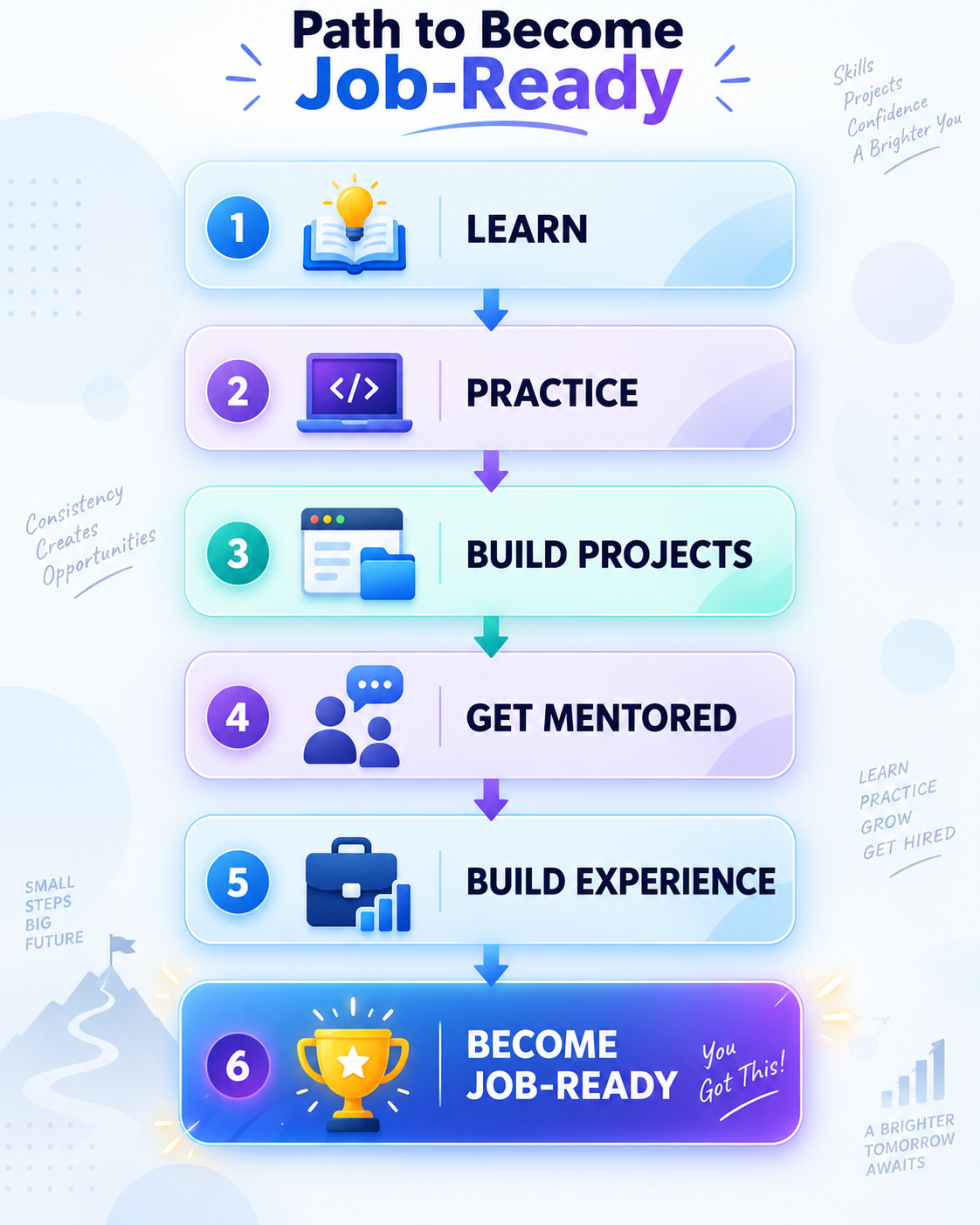
Best Career Options After 12th Science

If you’re from a Science background, your options span engineering, computer science, AI & data science, medical and healthcare fields, pharmacy, biotechnology, architecture, cybersecurity, and various research careers. Each of these builds on the analytical and problem-solving foundation Science students already have.

Science students in particular tend to have a natural head start in technology-adjacent fields, since the same logical thinking that helps in physics or chemistry translates directly into programming, data analysis, and systems thinking. This is exactly why so many Science students end up pairing their core degree with a practical technology skill on the side, rather than treating the two as separate tracks.

Best for students who enjoy: Maths | Biology | Computers | Problem-solving | Research

Career Options After 12th Commerce

Commerce opens the door to Chartered Accountancy, B.Com, BBA, finance, banking, economics, Company Secretary, entrepreneurship, and increasingly, digital business roles that didn’t exist a decade ago.

What’s changed most for Commerce students in recent years is just how much overlap now exists between traditional business education and digital skills. A Commerce graduate who understands digital marketing analytics, for instance, brings a genuinely valuable combination to any business role: numbers plus the ability to actually act on what the data shows.

Student Tip: Commerce can lead to careers in finance, business, management, entrepreneurship, and even modern digital industries; it’s far more flexible than it’s often given credit for.

Career Options After 12th Arts: Discover Where Creativity & Ideas Can Take You

Arts students can explore law, psychology, journalism and mass communication, design, social work, political science, languages, civil services, and teaching and education.

Arts is also where some of the strongest creative-technology careers live. Students who pair an Arts background with skills like UI/UX design or content-focused digital marketing often find themselves genuinely more employable than peers who chose a “safer” stream but built no practical skill alongside it.

Arts doesn’t mean fewer career opportunities. The right combination of education, specialization, and practical skills can open multiple career paths, many of them just as competitive and rewarding as anything in Science or Commerce.

Want to Build Skills Instead of Just Collecting Degrees? Here’s Where to Start

This is where things get genuinely interesting for a lot of students. You don’t have to choose between academics and practical skills; you can build real, in-demand skills alongside your degree, and this is exactly where a shift in mindset pays off long-term.

Think of it this way: a degree tells an employer you completed a program. A genuine, demonstrable skill a working app you built, a website you designed, a campaign you actually ran tells them you can do the job. Increasingly, employers are weighting the second kind of proof far more heavily than the first, especially for entry-level roles in technology and digital fields.

  • Technology: Web Development, Full-Stack Development, Mobile App Development, AI & Machine Learning, Data Analytics, Software Testing, Cybersecurity, Cloud & DevOps.
  • Digital: Digital Marketing, SEO, PPC, Social Media Marketing, Analytics.
  • Creative UI/UX Design, Web Designing, Figma, Digital Design.

These areas closely reflect the kind of practical training available through platforms like Skill Hives, including web development training, mobile app development, digital marketing course, AI/ML, and UI/UX built around real project experience and industry tools rather than pure classroom theory.

Ready to Explore a Skill-Based Path?

See which technology or digital skill actually fits you.

WhatsApp Us

From Classroom Knowledge to Real-World Skills: Why Practical Learning Matters

The path that actually builds a career looks like this: Theory → Practice → Projects → Portfolio → Internship → Career. Skipping straight from theory to job applications, with nothing built in between, is exactly why so many graduates struggle to stand out despite having good grades.

This gap shows up most clearly at interview time. A candidate who can only recite what they learned in a textbook struggles the moment an interviewer asks, “Can you show me something you’ve actually built?” A candidate who has even one or two genuine projects, however small has a real, concrete answer, and that difference matters far more to most employers than an extra percentage point on a transcript.

This is precisely the gap Skill Hives is built to close, bridging theory and practice through live projects, hands-on practical sessions, expert mentorship, and genuine industry exposure, rather than stopping at conceptual knowledge alone.

Looking for Practical IT Skills? See What Skill Hives Offers

Skill Area What Students Can Explore
Web Development Front-end, back-end, full-stack
Mobile App Development Android, iOS, cross-platform
Digital Marketing SEO, PPC, social media, analytics
AI & ML Artificial intelligence and machine learning
UI/UX User research, interface design, Figma
Web Designing Website design and practical tools

Skill Hives structures its programs around hands-on projects, industry mentorship, and practical exposure rather than focusing purely on theoretical learning. For students specifically curious about programming, a well-structured Python training program can be an excellent entry point into both web development and AI/ML paths. Students drawn more toward numbers and business insight often find a dedicated data analytics training track more aligned with their interests, while those fascinated by intelligent systems might explore a focused AI/ML course to go deeper into machine learning specifically.

Learn It. Build It. Practice It. The Skill-Based Career Approach

This cycle: not a single course completion certificate is what actually makes someone job-ready. Skill Hives’ approach leans heavily on live projects, practical sessions, one-to-one guidance, expert webinars, and collaborative learning, so students move through each stage of this cycle rather than stopping at “learn.”
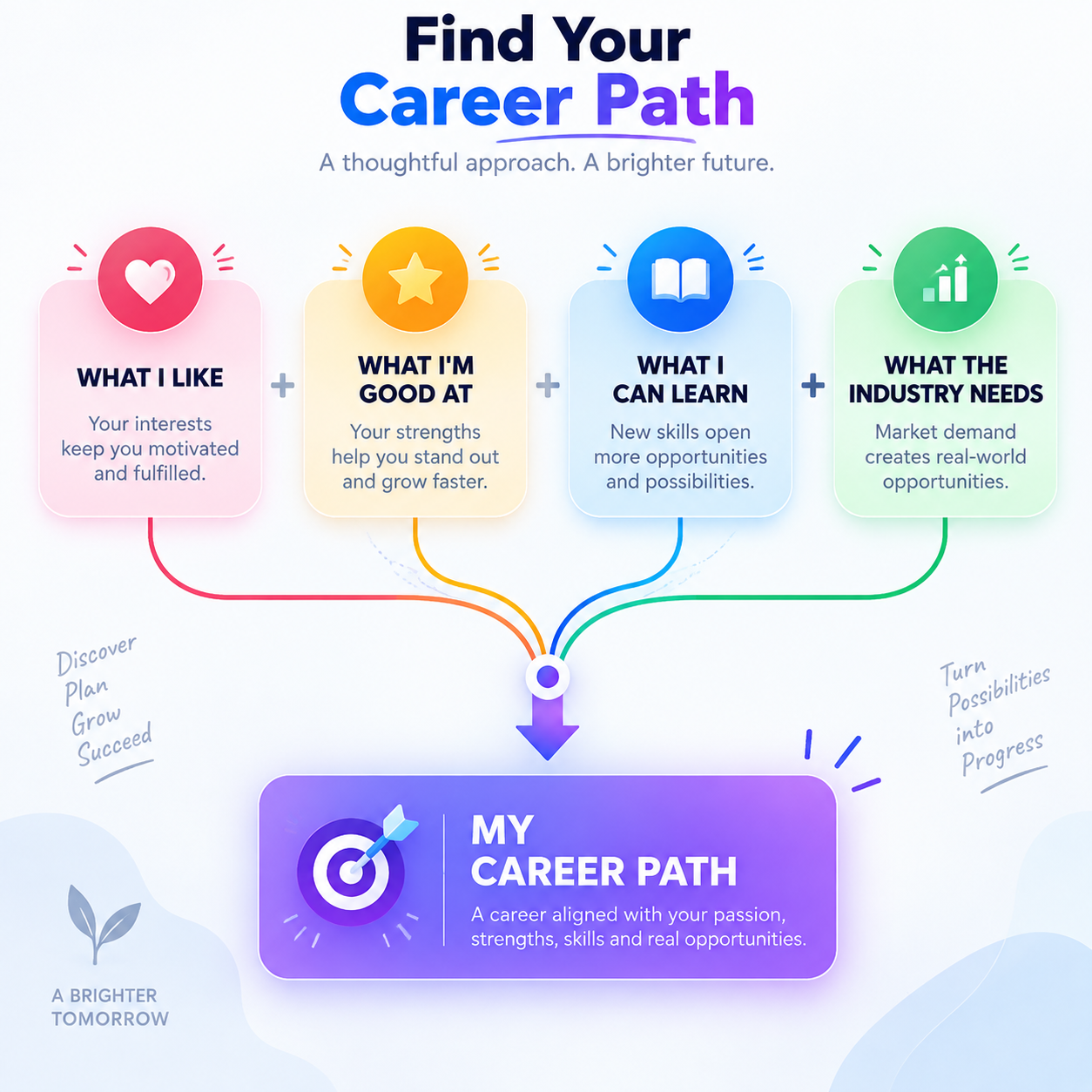
Want to Learn Through Real Projects, Not Just Lectures?

Explore a genuinely practical training path.

WhatsApp Us

How to Choose the Right Career After 12th?

Use this simple sequence: Interest → Strength → Skills → Course → Career Goal.
Ask yourself honestly: What subjects do I actually enjoy? What am I naturally good at? What kind of work genuinely interests me? What skills will I actually need to get there? What education or training is required? And importantly, can I gain real, practical experience in this field, or will I be stuck in theory for years before doing anything hands-on?

Notice that this sequence starts with you, not with what’s trending or what pays the most. A career chosen purely by following the highest salary numbers, without any genuine interest or aptitude behind it, tends to feel hollow within a few years, even if it looks impressive on paper.

Career After 12th: Which Path Sounds Like You?

If You Like… You Could Explore…
Maths + Technology Engineering, AI, Data
Biology + Healthcare Medical, Pharmacy, Nursing
Numbers + Business CA, Finance, B.Com
Creativity Design, UI/UX, Media
Communication Law, Journalism, Marketing
Computers Development, AI, Cybersecurity
Digital Business Digital Marketing, SEO, Analytics

If you’re someone who’s drawn to “Creativity” from this table, it’s worth knowing a structured web design course can turn that instinct into an actual, employable skill within months, not years.

Don’t Choose Your Career Just Because Someone Else Did

A few common mistakes worth avoiding entirely:
❌ Choosing because your friend chose it
❌ Choosing only because of salary
❌ Following family pressure without research
❌ Ignoring your own strengths
❌ Selecting a course without understanding it
❌ Focusing only on marks
❌ Ignoring practical skills

Your friend’s perfect career may not be your perfect career.

Still Confused? Use This Simple Career Formula

Run your own situation through this formula honestly, and you’ll usually land somewhere far more specific and far more genuinely yours than “whatever seems safe.”
Your Career Doesn’t Start After College. It Starts With What You Learn Today

Here’s the real takeaway for every Class 11 and 12 student reading this: explore before deciding, research before enrolling, and build skills alongside your academics rather than waiting until “later.” Work on real projects. Ask questions. Gain practical exposure wherever you can find it. And don’t be afraid to change direction once you learn more about yourself; that’s not failure, that’s the process working as it should.

If you’re specifically drawn toward practical IT and digital skills, whether that’s a focused Python training program, hands-on web development training, a creative web design course, or deeper data analytics training, Skill Hives is one option worth exploring as a best IT training company for students who want real, project-based learning. For students who want to go deeper before entering the job market, its 6-month industrial training track offers significantly more hands-on depth than a short course alone.

Still confused about your career after 12th? Start with your interests, explore the right career path, and build practical skills that can support your future with Skill Hives.

Ready to Turn Your Interests Into Real Skills?

Let’s figure out the right starting point together.

WhatsApp Us

Frequently Asked Questions

What are the best career options after 12th in 2027?

The best options depend on your stream and interests, spanning traditional paths like engineering, medicine, CA, and law, alongside fast-growing skill-based careers in web development, AI/ML, digital marketing, and design.

What are the best career options after 12th science?

Science students can explore engineering, computer science, AI & data science, medical and healthcare fields, pharmacy, biotechnology, architecture, and cybersecurity.

What are the career options after 12th commerce?

Commerce students can pursue Chartered Accountancy, B.Com, BBA, finance, banking, economics, Company Secretary, entrepreneurship, and digital business roles.

What are the career options after 12th arts?

Arts students can explore law, psychology, journalism, design, social work, political science, languages, civil services, and teaching.

What can I do after 12th if I don’t want engineering or medicine?

Skill-based careers in technology (web development, AI/ML, data analytics), digital marketing (SEO, PPC, social media), and creative fields (UI/UX, web design) offer strong, practical alternatives that don’t require a traditional engineering or medical path.

Can I learn IT skills after 12th?

Yes, students can start learning practical IT skills like web development, digital marketing, or UI/UX design right after 12th, often alongside a degree, through platforms like Skill Hives that focus on hands-on, project-based training.

AI Training in Chandigarh: Courses, Fees, Syllabus & Career Scope

Artificial Intelligence has become one of the most important skills across both technology and business, but most students hit the same wall early on: should you learn AI, Machine Learning, Generative AI, or Data Science? On top of that, you still need real answers on fees, syllabus, duration, eligibility, projects, and career opportunities before actually committing to a course.

This guide covers all of it. And if you’re specifically looking for AI Training in Chandigarh, Skill Hives is one option worth considering alongside anything else you’re evaluating in the Chandigarh/Mohali region, since it offers structured, practical training rather than a purely theoretical curriculum.

Ready to start your AI learning journey?

WhatsApp Us

Table of Content

What Is AI Training in Chandigarh?

Why Should You Learn AI in 2026?

What Does an AI Training Course in Chandigarh Cover?

AI Training in Chandigarh: Course Fees

What Is the Duration of AI Training in Chandigarh?

Who Can Join AI Training in Chandigarh?

Which AI Course Is Best for Beginners in Chandigarh?

How to Choose the Best AI Training Institute in Chandigarh?

What Jobs Can You Get After Learning Artificial Intelligence?

AI vs Machine Learning: Which Should You Learn First?

What Is Generative AI and How Can Beginners Learn It?

AI vs Machine Learning vs Generative AI

AI, ML or Data Science: Which Course Is Right for You?

AI Training in Chandigarh vs Learning AI Online

What Skills Should You Have After AI Training?

How to Build an AI Portfolio After Training?

Why Choose Skill Hives for AI Training?

Frequently Asked Questions

Final Thought

What Is AI Training in Chandigarh?

Quick Answer: AI training in Chandigarh is a structured learning program that teaches students the concepts, tools, and practical skills used to build and work with artificial intelligence systems. Depending on the course, training may cover Python, data handling, machine learning, deep learning, Generative AI, AI tools, and real-world projects.

Artificial Intelligence, in simple terms, is the field of building systems that can perform tasks typically requiring human intelligence recognizing patterns, making predictions, or generating content. A genuine AI course in Chandigarh should combine theoretical understanding with practical, hands-on training, since concepts alone rarely translate into usable skill without real project work. Whether you call it an AI course or simply AI classes in Chandigarh, the same standard applies theory alone isn’t enough.

Python, Machine Learning, and Generative AI are commonly connected with AI learning because they build on each other. Python provides the programming foundation, Machine Learning teaches systems to learn from data, and Generative AI focuses on creating new content using trained models. An Artificial Intelligence course in Chandigarh can benefit students from a wide range of backgrounds, from complete beginners to working professionals looking to add a high-demand skill.

Why Should You Learn AI in 2026?

Growing Use of AI Across Industries

AI is increasingly used across finance, healthcare, retail, and manufacturing, making relevant skills useful well beyond pure tech roles.

AI Skills Can Complement Existing Technical Skills

For developers, analysts, or marketers, AI knowledge often adds directly to an existing skill set rather than replacing it.

Generative AI Is Changing How Businesses Work

From content creation to customer support automation, GenAI tools are being adopted quickly across industries.

Practical AI Knowledge Can Strengthen Your Portfolio

Real AI projects demonstrate applied skill in a way theoretical knowledge alone can’t.

AI Can Be Combined With Web Development, Data Science and Digital Marketing

AI increasingly overlaps with other technical fields, making it a valuable addition rather than a standalone specialization.

It’s worth being direct here: learning AI does not guarantee a high-paying job on its own genuine skill, projects, and continuous learning still matter most.

What Does an AI Training Course in Chandigarh Cover?

Module What Students Learn
AI Fundamentals AI concepts, applications and terminology
Python for AI Python basics, functions, libraries and data handling
Mathematics for AI Basic statistics, probability and mathematical concepts
Data Handling Data cleaning, preparation and exploration
Machine Learning Supervised and unsupervised learning
Deep Learning Neural networks and deep learning fundamentals
Generative AI LLM concepts, AI applications and prompting
AI Tools Practical use of relevant AI tools
Model Evaluation Testing and evaluating AI models
Projects Applying concepts to practical use cases
Portfolio Development Presenting AI projects and skills

Actual module depth and coverage can vary by course duration confirm the specific syllabus directly with the institute before enrolling.

AI Training in Chandigarh: Course Fees

How Much Does AI Training Cost in Chandigarh?

Fees vary significantly by institute, course depth, duration, and practical components; there’s no single fixed number that applies everywhere. Rather than comparing price alone, it’s worth comparing curriculum depth and practical exposure, since two courses labeled “AI Training” can differ enormously in what’s actually included.

Pricing is generally influenced by course duration, whether the curriculum is beginner or advanced level, the number of modules covered, how much practical project work is included, trainer experience, certification offered, placement or career support, whether the format is offline or online, and batch size.

What Should You Compare Before Paying AI Course Fees?

Factor What to Check
Curriculum Does it cover current AI concepts?
Practical Work Are students building projects?
Trainer Relevant industry/teaching experience
Duration Enough time for practice?
Projects Beginner + advanced projects
Certification What does the certificate represent?
Support Doubt solving and mentoring
Career Support Portfolio/interview guidance

Have questions about fees or what’s included?

WhatsApp Us

What Is the Duration of AI Training in Chandigarh?

Training is typically available in 3-month, 6-month, and customized formats depending on your goals and current skill level.

How long does it take to learn AI?

Becoming comfortable with AI fundamentals can take considerably less time than becoming genuinely job-ready in advanced AI or Machine Learning. The actual timeline depends heavily on your prior programming knowledge and how many hours you actually put into practice, not just the course duration on paper.

Who Can Join AI Training in Chandigarh?

College Students exploring a future-focused technical skill early. Engineering Students looking to specialize beyond their core discipline. Computer Science Students building directly on existing programming knowledge. Graduates from any background exploring a technical career pivot. Working Professionals adding AI skills to an existing career. Beginners Interested in AI with genuine curiosity but no formal technical background yet.

Can a beginner learn AI?

Yes most structured courses are designed to start from fundamentals, so no prior AI-specific experience is required, though basic computer literacy helps.

Which AI Course Is Best for Beginners in Chandigarh?

Rather than claiming one course is universally “best,” here’s a framework based on your actual starting point:

For Complete Beginners – look for fundamentals, Python, and guided projects together. For Python Developers look for Machine Learning, Deep Learning, and AI application-focused content. For Students Interested in GenAI look for Generative AI, LLM concepts, and practical AI tool usage. For Data-Focused Students consider a path combining AI, Machine Learning, and Data Science. For Career Switchers prioritize structured learning, mentorship, and real portfolio projects.

Your Background Suitable Learning Path
Complete beginner AI fundamentals → Python → ML
Python learner Python → ML → AI projects
Data Science learner Statistics → ML → AI
Developer ML → Deep Learning → GenAI
Interested in GenAI AI basics → LLMs → GenAI projects

How to Choose the Best AI Training Institute in Chandigarh?

Which Is the Best AI Training Institute in Chandigarh?

Rather than any institute simply claiming to be “the best,” here’s how to actually evaluate one:

Check the curriculum for current, relevant AI content. Look for genuine practical projects, not just lecture-based teaching. Understand trainer expertise and real industry background. Ask about batch size, since smaller batches typically mean more individual attention. Check learning support and doubt-solving availability. Review course duration against your actual goals. Understand exactly what the certification represents. Ask about career support specifics. And confirm the course genuinely matches your current skill level and goal.

Why Consider Skill Hives for AI Training?

Skill Hives offers practical, project-based learning built around industry-relevant skills, with mentorship support and a career-focused approach to training. Its Chandigarh/Mohali location also connects students to the region’s growing IT and tech ecosystem, giving practical training added local relevance. As a broader top IT training company in the region, Skill Hives also connects AI training with related programs like Machine Learning training and data analytics training, useful for students wanting a more well-rounded technical foundation.

What Projects Are Included in a Practical AI Course?

What projects are included in a practical AI course?

Projects matter because they force you to apply concepts directly to real problems, rather than just absorbing theory passively; this is where genuine, demonstrable skill actually comes from.

Project Type Skills Practised
Prediction Model Data preparation + ML
Classification Project Classification algorithms
Recommendation System Data + recommendation concepts
Chatbot NLP/AI concepts
Image Classification Computer vision
Generative AI App LLM/GenAI concepts
Data Analysis Project Python + data handling

A genuinely good AI project includes a real problem, a clean dataset, a clear objective, an actual model or application, proper evaluation, documented results, and clear documentation of the whole process, not just a finished output with no explanation behind it.

What Jobs Can You Get After Learning Artificial Intelligence?

What jobs can you get after learning Artificial Intelligence?

Possible career paths include AI/ML Engineer, Machine Learning Engineer, AI Developer, Data Scientist, NLP Engineer, Computer Vision Engineer, Generative AI Developer, AI Automation Specialist, and Data/AI Analyst.

Does AI Training Guarantee a Job?

No. Training can help build relevant knowledge and projects, but actual employment depends on your skills, experience, portfolio, interview performance, education, and the specific role you’re applying for.

AI vs Machine Learning: Which Should You Learn First?

Artificial Intelligence is the broader field. Machine Learning is a major approach within AI where systems learn patterns from data rather than following fixed rules.

AI Machine Learning
Broader field Subfield of AI
Includes multiple approaches Focuses on learning from data
Covers reasoning, automation and intelligent systems Uses algorithms and data
Includes ML and other techniques One component of AI

Which Should a Beginner Learn First?

A common recommended path: AI fundamentals → Python → Data → Machine Learning → Deep Learning → Generative AI.

What Is Generative AI and How Can Beginners Learn It?

What is Generative AI?

Generative AI refers to AI systems that create new content, text, images, code, and more rather than simply analyzing or classifying existing data. It differs from traditional AI by focusing on generation rather than pure prediction, and it’s closely tied to Large Language Models (LLMs), which are power tools capable of text generation, image generation, AI assistants, and prompt-based applications.

Beginner Learning Path for Generative AI

AI basics → Python basics → Machine Learning fundamentals → LLM concepts → Prompting → AI applications → Projects.

It’s worth being clear that learning to use AI tools well is a useful, real skill but it isn’t equivalent to becoming a trained AI engineer capable of building these systems from scratch.

AI vs Machine Learning vs Generative AI

Technology Simple Meaning Beginner Focus
AI Broad field of intelligent systems AI fundamentals
Machine Learning Systems learn from data Algorithms + data
Deep Learning Neural-network-based ML Neural networks
Generative AI AI that generates new content LLMs + generative models

AI, ML or Data Science: Which Course Is Right for You?

If You Enjoy… Consider
Intelligent applications AI
Algorithms and prediction Machine Learning
Data, statistics and insights Data Science
LLMs and content generation Generative AI
Programming + intelligent systems AI/ML

Quick recommendation: Want broad AI knowledge? → AI. Want predictive modelling? → Machine Learning. Love statistics and data? → Data Science. Interested in LLMs and AI applications? → Generative AI.

AI Training in Chandigarh vs Learning AI Online

Offline Training Online Learning
Direct trainer interaction Flexible schedule
Classroom environment Learn from anywhere
Immediate doubt solving Self-directed learning
Structured routine More flexibility
Peer interaction Wider course options

The better choice genuinely depends on your learning style, schedule, budget, and how much direct support you need along the way.

What Skills Should You Have After AI Training?

Technical Skills: Python, data handling, Machine Learning, basic statistics, model evaluation, AI concepts, and Generative AI fundamentals.

Practical Skills: Problem solving, project development, data interpretation, model testing, documentation, and portfolio building.

How to Build an AI Portfolio After Training?

Build 2–4 genuinely meaningful projects rather than many shallow ones. For each project, document the problem you were solving, explain the dataset you used, walk through your approach, show your actual results, mention the technologies and tools involved, and add the project to a portfolio or GitHub profile where appropriate. A well-documented smaller portfolio consistently outperforms a large pile of unexplained code when it comes to actually impressing an employer.

Why Choose Skill Hives for AI Training?

  • Practical Learning — training built around applying concepts through real exercises and projects, not lecture-only delivery.
  • Industry-Relevant Skills — curriculum connected to current, real-world AI tools and techniques, not outdated material.
  • Project-Based Learning — students practice concepts directly through hands-on project work throughout the course.
  • Mentorship — guided support to help students navigate concepts and career direction as they progress.
  • Career-Focused Approach — portfolio and career preparation built into the training, helping students walk away with more than just a certificate.
  • Ready to start learning AI? Explore AI training options at Skill Hives and choose a learning path based on your current skills and career goal.

Give Your Career a Big Boost With AI

WhatsApp Us

Frequently Asked Questions

What is AI Training in Chandigarh?

It’s a structured learning program teaching students AI concepts, tools, and practical skills, covering areas like Python, Machine Learning, and Generative AI depending on the specific course.

How much does AI training cost in Chandigarh?

Fees vary by institute, course depth, and duration compare curriculum and practical exposure rather than price alone before choosing.

What is the syllabus of an AI course?

A typical syllabus covers AI fundamentals, Python for AI, mathematics for AI, data handling, Machine Learning, Deep Learning, Generative AI, AI tools, and practical projects.

How long does AI training take?

Programs are commonly available in 3-month, 6-month, or customized durations, depending on depth and your existing background.

Can beginners learn AI?

Yes, most structured courses are designed to start from fundamentals, requiring no prior AI-specific experience.

What programming language is used for AI?

Python is the most commonly used programming language for AI and Machine Learning work.

Is Python necessary for AI?

For most technical AI and ML work, yes. For basic use of existing GenAI tools, Python isn’t strictly necessary.

Which is better, AI or Machine Learning?

Neither is “better” AI is the broader field, while Machine Learning is a specific approach within it focused on learning from data.

What jobs can I get after AI training?

Possible roles include AI/ML Engineer, Data Scientist, AI Developer, NLP Engineer, and Generative AI Developer, among others, depending on your specialization.

Is AI a good career option in 2026?

Yes, given its growing use across industries, though success still depends on genuine skills, projects, and continuous learning rather than the course alone.

What is Generative AI?

Generative AI refers to AI systems capable of creating new content such as text, images, or code, rather than only analyzing existing data.

Should I learn AI, ML or Data Science?

It depends on your interest, broad intelligent systems point toward AI, prediction and algorithms point toward Machine Learning, and data-driven insights point toward Data Science.

Final Thought

Choosing between AI, Machine Learning, Generative AI, or Data Science ultimately comes down to your current skills, interests, and career goals, there’s no single universally “right” starting point for every student. What matters most is choosing training that combines real curriculum depth with genuine practical project work, rather than picking based on trend or price alone.

If you’re exploring AI training institutes in Chandigarh options or looking for a best industrial training in Chandigarh , experience that goes beyond AI into a broader technical skill set Skill Hives is worth evaluating using the same criteria covered throughout this guide, including its 6 month training track for students seeking deeper, more comprehensive preparation.

Python, Machine Learning, or GenAI: Which Course Is Right for You?

If you’re trying to enter the AI/tech field, you’ve probably run into the same wall most students do: Python, Machine Learning, and GenAI courses all keep showing up when searching for an IT training company, and all three sound important. Whether you are looking for short-term skill development or a 6 months industrial training program, picking the wrong starting point can make learning harder than it needs to be because these fields serve genuinely different purposes.

This guide is built to fix that confusion. By the end, you’ll know what Python, Machine Learning, and GenAI actually mean, what you’ll learn in each course, who should choose each one, what skills you need before starting, and which learning path is likely to suit you best based on your current knowledge, interests, and career goals.

Ready to fast-track your tech career?

Explore our 6 months industrial training program today!”

WhatsApp Us

Python, Machine Learning and GenAI: What Is the Difference?

Here’s the simple version before we go deeper:

Technology Simple Meaning Main Purpose
Python A programming language Build programs and applications
Machine Learning A way for computers to learn from data Make predictions and decisions
GenAI AI that can create new content Generate text, images, code and more

Python is the foundation a language used to write instructions a computer can follow. Machine Learning builds on that foundation, using code and data together to let a system identify patterns and make predictions rather than following fixed rules. GenAI goes a step further, using trained models to actually generate new content, text, images, code rather than just analyzing existing data.

What Is Python and Why Is It Important for AI?

What Can You Do With Python?

Python is used to build applications, automate repetitive tasks, work with and analyze data, create websites, and increasingly, work directly with AI and ML tools and libraries.

What Will You Learn in a Python Course?

A solid Python training program typically covers variables, data types, conditions, loops, functions, object-oriented programming, commonly used libraries, and hands-on beginner projects to apply everything you’ve learned.

Who Should Learn Python?

Python suits complete beginners, college students, students specifically interested in coding, students planning to eventually enter AI/ML, and anyone simply wanting a solid programming foundation before specializing further.

Do You Need Previous Coding Experience?

No. Python is generally a strong starting point for students who are completely new to programming.

What Is Machine Learning?

Think about how Netflix recommends a movie, or how an online store suggests a product you might like, machine learning is what powers that. It helps systems identify patterns in existing user data and use those patterns to make predictions, without a programmer writing an explicit rule for every possible scenario.

How Does Machine Learning Work?

In simple terms: Data → Training → Model → Prediction.

What Will You Learn in Machine Learning?

A typical ML course covers Python basics, data handling, data preprocessing, core ML algorithms, model training, model testing, prediction, and practical, hands-on projects.

Who Should Learn Machine Learning?

This path suits students interested in AI generally, students who enjoy problem-solving, students drawn to working with data, students who already know basic Python, and anyone aiming toward a technical AI career.

Is Machine Learning Difficult for Beginners?

Honestly, yes more so than basic Python. ML often requires understanding coding, data handling, some statistics, and algorithmic thinking together, which is why it’s usually easier to approach after some programming foundation is already in place.

What Is Generative AI?

What Can Generative AI Do?

GenAI can generate text, create images, generate code, summarize information, help brainstorm ideas, and power entire AI-driven applications built around these capabilities.

What Do You Learn in a GenAI Course?

Depending on the specific course, students may learn generative AI concepts, prompt engineering, how large language models work, working with AI tools and APIs, AI application development, AI automation, and practical, applied projects.

Who Should Learn GenAI?

This path fits students interested in modern AI tools specifically, developers, students interested in building AI-powered applications, anyone curious about LLMs, and students who want to build real, usable AI-driven solutions.

Can You Learn GenAI Without Python?

It depends on your goal. For basic GenAI usage, using existing tools and prompting effectively, Python may not be necessary at all. For technical GenAI development, actually building applications or working with APIs, Python and general programming knowledge become genuinely useful.

Python vs Machine Learning vs GenAI: Complete Comparison

Factor Python Machine Learning GenAI
Beginner Level Easy Moderate Moderate
Main Focus Programming Data & prediction AI content generation
Coding Required Required Depends on course
Mathematics Low Medium/High Depends
Best Starting Point Yes Usually after Python Depends on goal
Good For Coding foundation AI/ML Modern AI applications
Practical Work Programs & automation ML models AI applications
Recommended For Beginners Aspiring ML learners AI-focused learners

Which Course Should You Choose Based on Your Goal?

If You Are Completely New to Coding

Choose Python. It’s the most beginner-friendly entry point, and everything else in AI eventually builds on programming fundamentals anyway.

If You Already Know Python

Consider Machine Learning. You already have the foundation needed to focus on data, algorithms, and model-building without getting stuck on basic syntax.

If You Want to Build AI Applications

Consider GenAI. Skills like prompt engineering, working with APIs, and understanding LLMs will help you build real, usable AI-powered tools.

If You Want a Long-Term AI Career

A common progression looks like Python → Machine Learning → GenAI though this is one possible path, not a compulsory rule everyone has to follow in that exact order.

Which Course Is Right for You? Quick Decision Table

Your Situation Best Starting Choice
I have never coded before Python
I want to learn programming Python
I know basic Python Machine Learning
I enjoy working with data Machine Learning
I want to understand AI models Machine Learning
I want to work with ChatGPT-like technology GenAI
I want to build AI applications GenAI + Python
I want a broader AI learning path Python → ML → GenAI

What Should You Know Before Starting Each Course?

Course What You Should Know Before Starting
Python Basic computer knowledge
Machine Learning Python basics, basic mathematics and data concepts
GenAI Basics Basic AI understanding and willingness to experiment
Technical GenAI Python/programming can be helpful

Keep in mind that prerequisites can vary somewhat from one institute or course to another, so it’s always worth confirming directly before enrolling.

What Skills Will You Build After Each Course?

  • Python Skills — programming logic, problem-solving, automation, application development, and working comfortably with Python libraries.
  • Machine Learning Skills — With ML courses you can build skills including data preparation, model building, model evaluation, prediction, and a real understanding of how different ML algorithms actually work.
  • GenAI Skills — effective prompting, working with AI models directly, AI application development, LLM-based workflows, and AI automation.

What Projects Can Students Build?

Course Example Beginner Projects
Python Calculator, automation tool, simple application
Machine Learning House price prediction, spam detection, recommendation system
GenAI AI chatbot, content assistant, document Q&A tool

Projects matter because they force you to apply concepts directly, rather than just watching lessons passively; this is exactly where real, demonstrable skill actually comes from.

Career Options After Learning Python, ML or GenAI

Learning Area Possible Career Direction
Python Python development, automation, software development
Machine Learning ML, data science, AI development
GenAI GenAI development, AI applications, LLM-based solutions

Important note: Completing a course alone does not guarantee a job. Students also need practical skills, real projects, problem-solving ability, and continuous learning to actually become job-ready.

How Long Does It Take to Learn Python, Machine Learning or GenAI?

Rather than promising something unrealistic like “learn AI in 30 days,” it’s more honest to think in stages: basic understanding, intermediate skills, project-level skills, and finally, job-ready development. How long each stage takes genuinely depends on your prior knowledge, how much you actually practice, and how deep the specific course goes. Two students in the same course can reach job-readiness at very different speeds.

Should You Learn Python Before Machine Learning and GenAI?

Short answer: For students planning a technical AI career, learning Python first can make Machine Learning and GenAI significantly easier to understand.

That said, this isn’t a universal rule. If you only want to explore GenAI tools at a basic, usage level, prompting existing tools rather than building your own applications, you may not need Python first at all.

Common Mistakes Students Make When Choosing an AI Course

  1. Choosing a course only because it’s trending, without checking if it fits your actual goal.
  2. Starting advanced AI without basic programming knowledge, which usually backfires quickly.
  3. Choosing a course based only on salary claims, rather than genuine interest and fit.
  4. Ignoring practical projects, focusing only on watching lessons.
  5. Choosing a course without checking the syllabus in detail first.
  6. Thinking one certificate is enough for a career, without building real, demonstrable skills alongside it.

How to Choose the Right Training Institute

Before choosing where to study, run any institute through this checklist:

Check the Course Syllabus

Does it actually cover the specific skills you want to learn, in real depth?

Look for Practical Learning

Check whether students genuinely work on projects and assignments, not just watch recorded lessons.

Check Trainer Experience

You should understand who’s actually teaching you and how the course is delivered day to day.

Ask About Doubt Support

This matters especially for beginners, who need consistent access to help when they get stuck.

Check Whether the Course Matches Your Level

A complete beginner shouldn’t blindly jump into an advanced course just because it sounds impressive.

Look at the Learning Environment

Consider the class format, how much hands-on practice is built in, and how much real project exposure you’ll actually get.

Why Choose Skill Hives for Your Learning Journey?

Skill Hives takes a practical, project-based approach to technology training, rather than relying purely on theory-heavy lectures. Courses are built to be industry-focused and beginner-friendly, with a genuine emphasis on technical, career-oriented skills, covering areas including Python training, AI, Machine Learning, data analytics training, and other in-demand technology skills.

Students looking to build real, practical experience, not just watch tutorials, get support throughout the learning process, with guidance suited to wherever they’re actually starting from. Skill Hives can be considered by students who want structured technology training with a genuine focus on practical learning and industry-relevant skills, whether you’re just starting with Python or aiming toward a specific AI specialization.

Python, Machine Learning or GenAI: Which One Should You Start With?

Here’s the simplest possible version of the decision:

  • Choose Python if: You’re starting from zero.
  • Choose Machine Learning if: You already know Python and want to understand how machines actually learn from data.
  • Choose GenAI if: You want to explore or build applications using modern generative AI.

Want to build broader AI skills? Python → Machine Learning → GenAI.

You don’t necessarily need to learn everything at once many students start with just one of these, build real confidence, and expand from there once they’ve got a solid footing.

Still unsure which path fits your goals?

Kickstart your Python, ML, or GenAI journey with top-tier 6 months industrial training from a trusted IT training company.

WhatsApp Us

Frequently Asked Questions

Which is better for beginners, Python or Machine Learning?

Python is better for complete beginners, since it builds the programming foundation Machine Learning relies on.

Should I learn Python before Machine Learning?

Yes, for most technical learners, Python knowledge makes Machine Learning significantly easier to understand and apply.

Can I learn GenAI without Python?

For basic usage, yes. For technical GenAI development and building applications, Python and programming knowledge become genuinely useful.

Is Machine Learning harder than Python?

Generally yes, since ML combines coding with data handling, statistics, and algorithmic thinking, while Python alone focuses on programming fundamentals.

Is GenAI suitable for college students?

Yes, especially for students interested in modern AI tools and applications, many GenAI concepts are accessible even without a deep technical background.

Which course is best for an AI career?

It depends on your specific direction: Python for a coding foundation, Machine Learning for data-driven AI roles, and GenAI for building modern AI-powered applications.

What should I learn before Machine Learning?

Basic Python programming, along with some foundational mathematics and general data concepts, makes Machine Learning much easier to approach.

What can I build after learning Python?

Beginner projects like calculators, automation tools, and simple applications are common early wins.

What can I build after learning Generative AI?

Common, practical GenAI starting points include an AI chatbot, a content assistant, or a document Q&A tool.

Which course should I choose if I have no coding experience?

Python, it’s specifically designed to be approachable for students with zero prior coding background.

Final Takeaway

No single course is best for every student. Your choice should genuinely depend on your current skill level, your interest, your career goal, and the type of work you actually want to do.

A simple roadmap to keep in mind:

Beginner → Python Python learner → Machine Learning AI application focused → GenAI Long-term AI path → Python → ML → GenAI

Whichever path fits you best, choosing based on genuine interest and a clear goal rather than what’s simply trending is what actually leads to real, usable skills by the end of the course. And, if you are looking for such a perfect option, Skill Hives is the one that ticks all the boxes.